


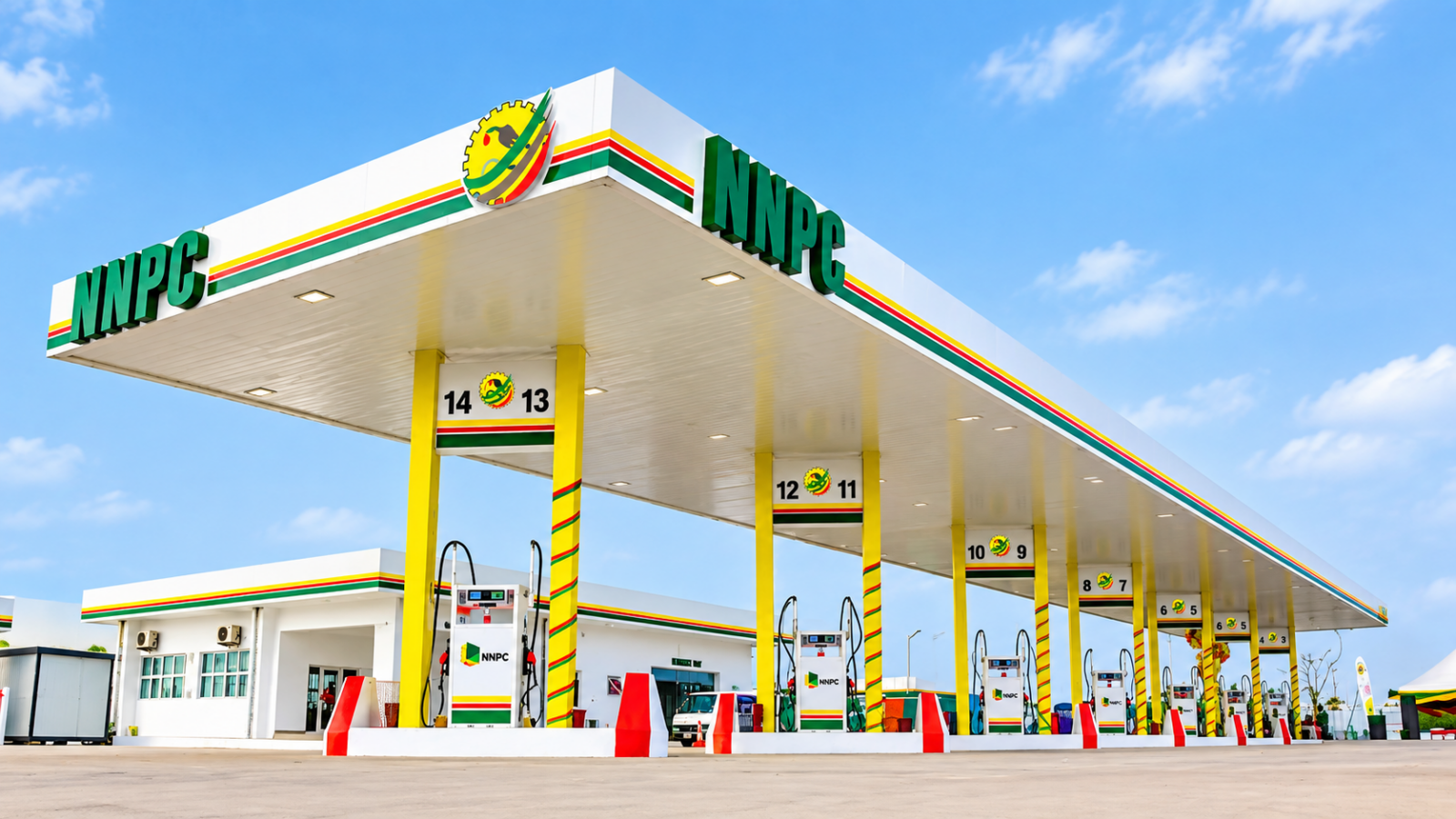
The Nigerian National Petroleum Company Limited (NNPC Ltd.) is accelerating the transformation of its retail network, with plans to roll out between 50 and 70 smart, self-service filling stations across Nigeria within the next six months.
The initiative marks a significant shift from the conventional petrol-station model as the national oil company moves towards technology-driven energy hubs that will combine fuel dispensing with electric-vehicle charging, gas services and other mobility-related facilities.
The Executive Vice President, Downstream, NNPC Ltd., Dr Mumuni Dagazau, disclosed the plan on Thursday, September 10, 2026, during the commissioning of the NNPC Retail Ltd. smart mega fuelling station along Bill Clinton Drive, Airport Road, Abuja.
The newly commissioned Abuja facility, described as the first of the new generation of NNPC smart stations, is powered by a 200-kilowatt-hour solar system and has a storage capacity of 180,000 litres of Premium Motor Spirit (PMS) and 45,000 litres of Automotive Gas Oil (AGO).
It has 16 PMS dispensing pumps and two AGO pumps, while motorists can also access self-service fuel dispensing, electric vehicle charging, gas dispensing, automated car washing and vehicle servicing.
Dagazau said the nationwide rollout was driven by changing customer expectations and advances in technology, stressing that NNPC intended to move beyond the traditional concept of a filling station.
“We are hoping to roll out a significant number, probably about 50 to 70 of these types of stations within the next six months,” he said.
According to him, the new facilities will integrate different forms of energy, including petrol, gas and electricity, allowing motorists to obtain several services at one location.
“What the whole concept is, we are trying to turn from a filling station to an energy hub,” Dagazau said.
The smart stations will also introduce greater automation into fuel retailing. Customers will be able to dispense fuel themselves and make payments through the NNPC Retail mobile application, including during night-time operations.
Dagazau said the application would be free to download, while personnel would remain available to assist customers who experience difficulties using the digital system.
The facilities are also expected to support Nigeria’s transition towards alternative energy and mobility. Alongside petrol, the stations will offer Liquefied Petroleum Gas (LPG), Compressed Natural Gas (CNG) and electric-vehicle charging services.
The Abuja facility’s fast EV chargers are capable of fully charging a vehicle in about 30 to 40 minutes, depending on the vehicle and the level of charge in its battery.
NNPC also plans to incorporate CNG vehicle-conversion facilities at some of the smart stations, potentially allowing motorists to convert their vehicles while accessing fuel and other services.
The initial expansion is expected to include additional smart facilities in Abuja, with about four or five more planned for the Federal Capital Territory. Two others are also expected to be launched in Kano.
The company intends to achieve the rollout partly through the modernisation of existing NNPC retail outlets, while new facilities will be developed in locations where customer demand justifies the investment.
The move into self-service retailing has raised questions about the future of filling-station attendants, but Dagazau dismissed concerns that automation would translate into widespread job losses.
He argued that the broader range of services provided by the new energy hubs would create employment opportunities in areas such as customer support, automation, EV charging, maintenance and facility management.
“What we are doing is creating jobs. Somebody has to support the integration and automation, while personnel are also needed to support customers using the EV facilities,” he said.
The smart-station project comes as Nigeria’s downstream petroleum industry continues to undergo major changes, including the expansion of alternative-fuel options and the increasing use of technology in petroleum retailing.
For NNPC, the new model represents an attempt to make its retail network more responsive to motorists who increasingly require access to different energy sources and services beyond conventional petrol and diesel.
Dagazau said the company could not afford to leave its retail outlets operating entirely in the traditional manner as technology and consumer preferences evolve.
“We cannot ignore innovation and technology and leave our stations the way they have always been. In the next few years, most NNPC stations will look like this,” he said.
The planned rollout therefore represents more than an expansion of filling stations. It is an attempt by NNPC to reposition its retail business around a broader energy-and-mobility model, bringing petrol, gas, electricity, vehicle services and digital transactions together in a single location.
If the six-month target is achieved, motorists across Nigeria could begin to see a substantially different NNPC retail landscape, with self-service technology and multiple energy options becoming increasingly common.











Leave a comment