


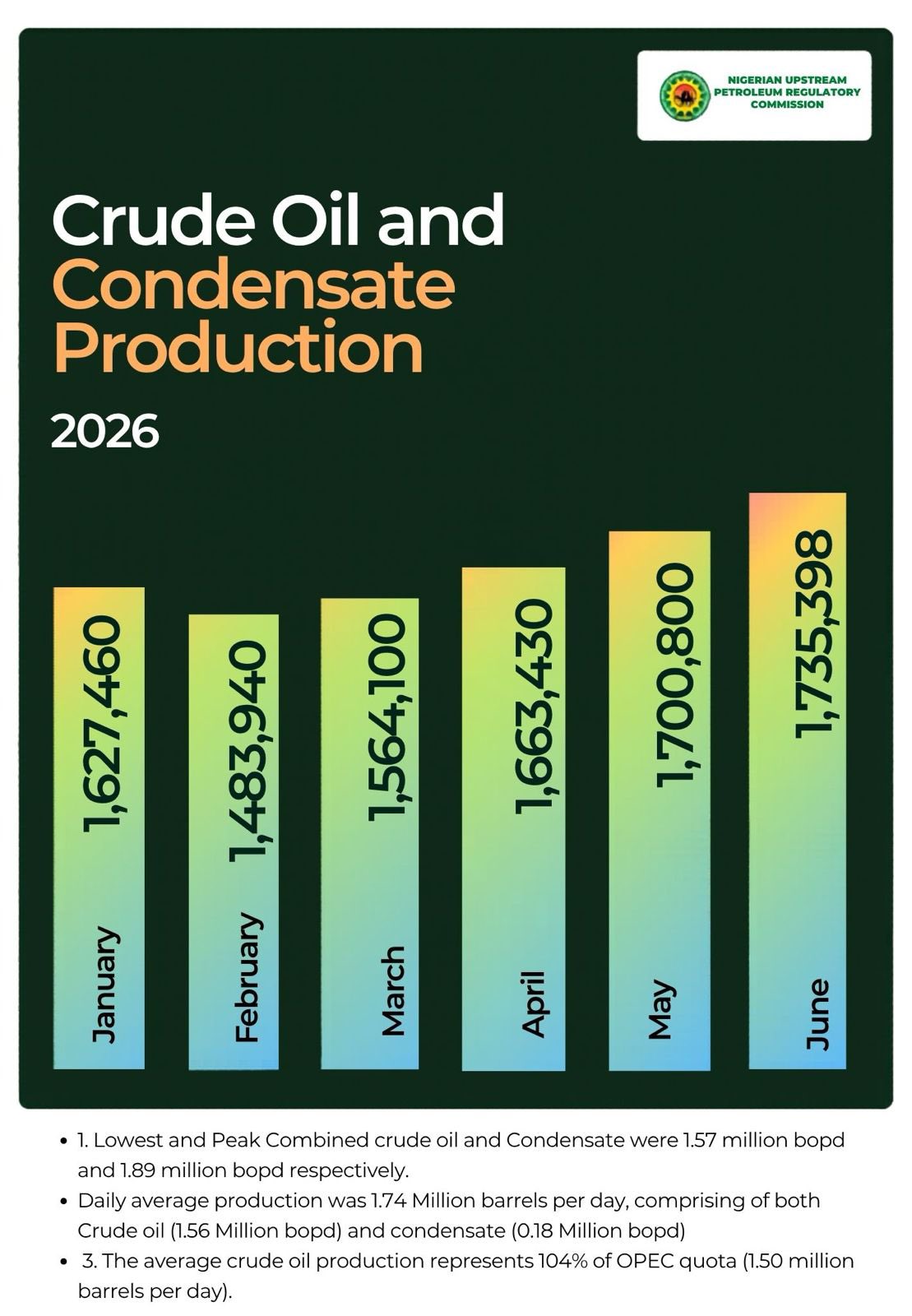
Nigeria’s oil industry recorded a major milestone in June 2026 as the country’s combined crude oil and condensate production climbed to an average of 1.735 million barrels per day (mbpd), surpassing its Organisation of Petroleum Exporting Countries (OPEC) production quota and reaching its highest output level in more than six years.
The latest production figures show that Nigeria achieved 104 per cent of its OPEC crude oil production quota of 1.5 million barrels per day, reinforcing growing confidence in the country’s ability to sustain higher output levels and strengthen its position as Africa’s leading oil producer.

According to industry data released on Sunday, Nigeria produced an average of 1.56 million barrels of crude oil per day in June, alongside approximately 180,000 barrels of condensates daily, marking the fourth consecutive month of production growth.
Significantly, the June crude oil production figure of 1.56 million barrels per day, excluding condensates, represents the highest level recorded by Nigeria since April 2020, making it the country’s strongest crude oil performance in 74 months.
The achievement reflects a steady upward trend in production over recent months. Nigeria’s combined crude oil and condensate output rose from 1.483 million barrels per day in February to 1.546 million barrels per day in March, increased further to 1.663 million barrels per day in April, climbed to 1.700 million barrels per day in May, and reached 1.735 million barrels per day in June, representing a month-on-month growth of approximately 2.2 per cent.
Industry analysts attribute the improved performance largely to enhanced operational stability across producing assets, improved asset management and the absence of major pipeline disruptions during the review period.
The report noted that uninterrupted production activities across most oil fields significantly improved production uptime and facilitated efficient evacuation of crude oil from key export terminals.
Although a few producing assets experienced temporary operational shutdowns during the month, their overall impact on national production remained negligible. Scheduled maintenance programmes were also successfully executed without causing significant interruptions to production activities.
Observers say the sustained increase in output underscores the commitment of operators, regulators and industry stakeholders to improving efficiency, maintaining critical infrastructure and strengthening production reliability within Nigeria’s upstream petroleum sector.
The June figures also highlighted Nigeria’s growing capacity to achieve even higher production levels in the near future. During the month, the country’s peak combined crude oil and condensate production reached 1.89 million barrels per day, bringing Nigeria closer to the long-standing target of producing 2 million barrels daily.
However, production fluctuated during the month, with the lowest daily output standing at 1.57 million barrels per day.
A breakdown of production by export terminals showed that Bonny Terminal remained the country’s highest-producing stream, contributing an average of 318,280 barrels per day, up from 293,880 barrels per day recorded in May.
Forcados Terminal followed closely with an average production of 306,360 barrels per day, compared to 289,900 barrels per day in the previous month.
Qua Iboe Terminal recorded an average output of 164,730 barrels per day, slightly lower than the 173,360 barrels per day achieved in May.
Production from Escravos Terminal increased to 138,030 barrels per day, up from 135,470 barrels per day recorded in May, while Bonga Field ranked among the top-performing assets with an average daily output of 103,660 barrels, marginally higher than the 102,540 barrels per day produced in the preceding month.
Industry stakeholders believe the latest performance demonstrates the resilience of Nigeria’s oil sector and the effectiveness of ongoing efforts to curb production losses, improve infrastructure reliability and maximise output from existing assets.
The sustained growth is also expected to boost government revenue, improve foreign exchange earnings and support broader economic recovery efforts as the country continues to pursue higher production targets.








Leave a comment