


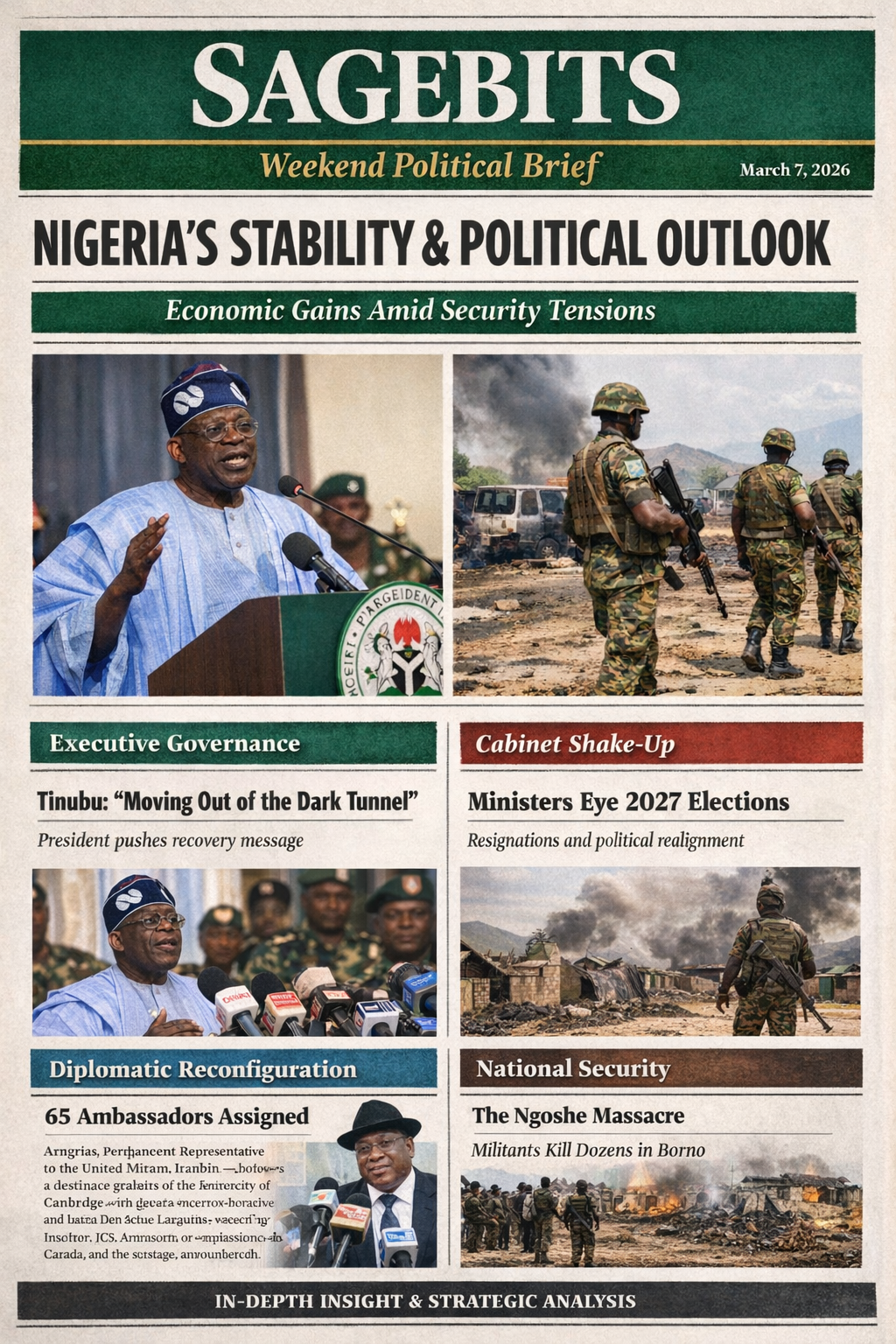
Nigeria Geopolitical & Socio-Economic Stability Analysis
Nigeria’s political and economic landscape in early March 2026 reflects a mixed trajectory of gradual economic stabilisation and persistent security challenges.
While reforms introduced by the administration of Bola Ahmed Tinubu are beginning to show early indicators of fiscal and macroeconomic resilience, the country continues to face complex internal security threats and mounting political manoeuvring ahead of the 2027 general elections.
This report reviews current developments across executive governance, political strategy, and national security dynamics, highlighting both emerging stability and structural risks within the Nigerian state.
Executive Governance and the “Prevail” Narrative
The Tinubu administration has shifted its messaging from the defensive tone that characterised the early phase of economic reforms toward a narrative of recovery and national endurance.
During an interfaith breaking of fast with members of the Nigerian Armed Forces at the Presidential Villa in Abuja, President Tinubu argued that Nigeria is “moving out of the dark tunnel,” framing ongoing economic hardship as the necessary cost of structural reform.
The messaging appears aimed at maintaining public patience following major policy shifts—particularly subsidy removal and currency reforms—that triggered short-term economic pain but were presented by the administration as foundations for long-term economic stability.
Cabinet Realignment and the 2027 Electoral Cycle
Political positioning ahead of the 2027 elections is already reshaping the Federal Executive Council.
Several senior ministers are reportedly considering resignation in order to pursue gubernatorial ambitions in their respective states. Such moves are expected in the coming months due to provisions of Nigeria’s Electoral Act requiring political appointees to step down before participating in party primaries.
With the Independent National Electoral Commission expected to schedule party primaries in the second quarter of 2026, the potential exit of multiple cabinet members could trigger a strategic reshuffle within the administration.
Beyond administrative adjustments, these transitions may also signal the early consolidation of political alliances ahead of what is expected to be a highly competitive 2027 electoral cycle.
Diplomatic Reconfiguration and International Representation
In a major move to address Nigeria’s global presence, the President approved the posting of 65 ambassadors—comprising 31 career and 34 non-career diplomats—who were confirmed by the Senate in late 2025.
This deployment includes high-profile appointments, such as Senator Jimoh Ibrahim as Nigeria’s Permanent Representative to the United Nations.
Ibrahim, a doctorate graduate of the University of Cambridge with degrees from Oxford and the London School of Economics, is expected to bring a high level of intellectual rigor to Nigeria’s multilateral engagements.
However, the scale and nature of these postings have drawn sharp criticism from the African Democratic Congress (ADC), which characterized the deployment as inadequate and raised concerns about the overall effectiveness of Nigeria’s diplomatic representation in an increasingly fractured global order.
Further appointments include former Health Minister Isaac Adewole as the ambassador to Canada, and the strategic assignment of ambassadors to both Iran and Israel amidst the escalating conflict in the Middle East.
National Security: The Complex Arc of Insurgency and Abduction
The security situation on March 7, 2026, remains the primary threat to Nigerian state stability, characterized by a transition from traditional insurgency to a “crisis economy” centered on mass abductions and unconventional ransom demands. While Presidential aides like Daniel Bwala maintain that the situation is not deteriorating and must be viewed in a global context, recent events in Borno and the Northwest tell a more harrowing story.
The Ngoshe Massacre and the Borno Crisis
The most severe breach of security this week occurred in the Ngoshe community of Gwoza Local Government Area, Borno State. Suspected Boko Haram militants executed a coordinated raid shortly after the breaking of the fast, resulting in the killing of the town’s chief imam, community elders, and military personnel.










Leave a comment