


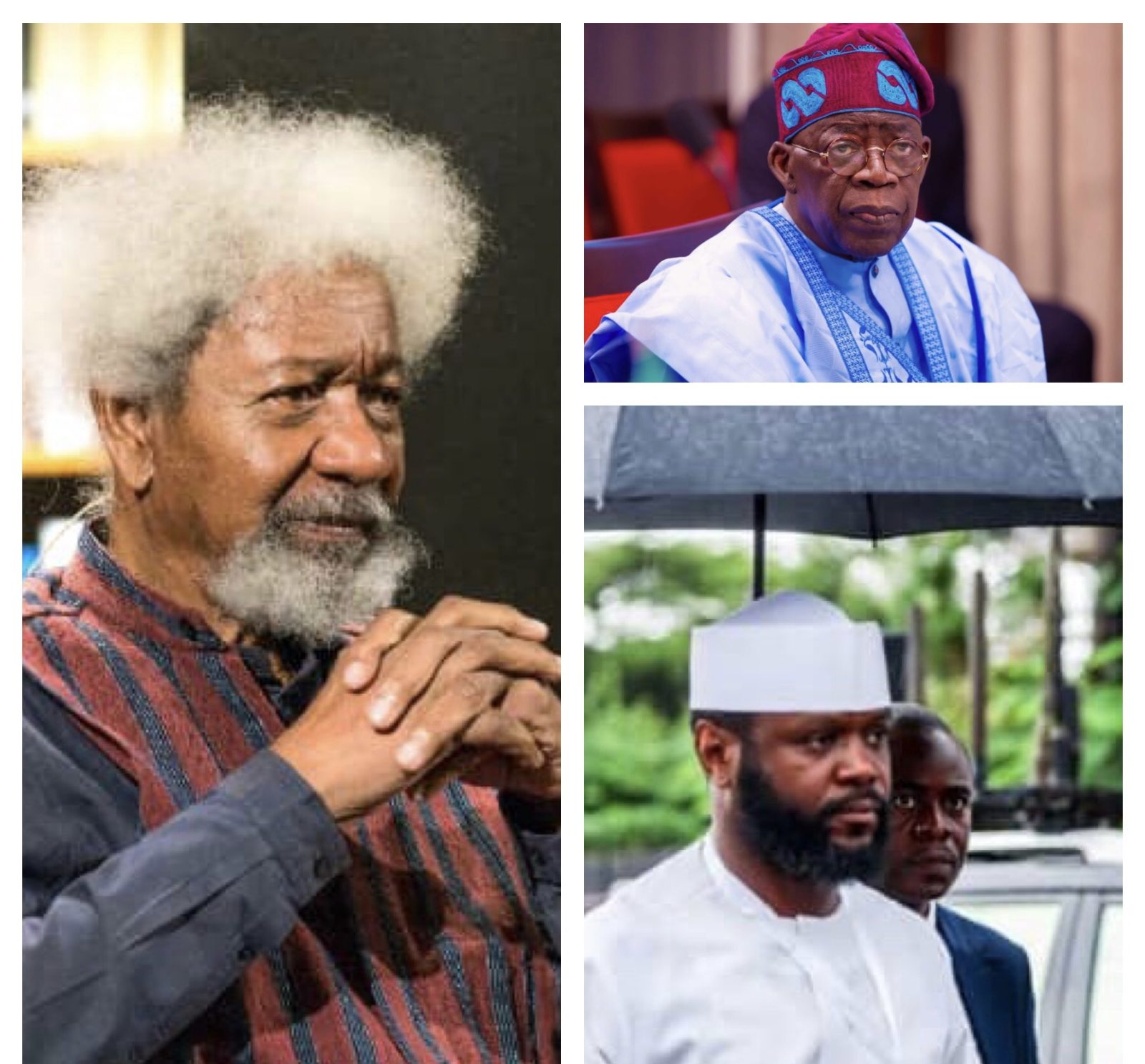
Nobel laureate Prof. Wole Soyinka has raised fresh concerns over Nigeria’s security priorities after witnessing an unusually large security detail escorting Seyi Tinubu, son of President Bola Tinubu, during an outing at a Lagos hotel.
Soyinka noted that the convoy—consisting of at least 15 armed operatives—resembled a presidential security formation rather than an escort for a private citizen with no official role in government.
Speaking at the 20th Wole Soyinka Centre for Investigative Journalism (WSCIJ) Awards in Lagos, he joked that the security team would have been more useful quelling the recent attempted coup in Benin Republic.
“Why send the military?” he asked humorously. “Next time there’s an uprising, just call Seyi and tell him to go and put it down.”
Behind the humour was a sharp critique: Nigeria’s security system is overburdened, under-resourced, and yet heavily deployed to protect VIPs who hold no public office.

Only weeks earlier, President Tinubu had ordered the withdrawal of police officers attached to politicians and VIPs so that more personnel could be deployed to communities battling insecurity.
“We need all the forces we can utilise on the streets,” the President had said.
Yet, shortly afterwards, his son appeared in public with a security detail that many Nigerians described as excessive. Critics argue that such contradictions undermine the government’s credibility and highlight long-standing concerns about unequal access to state protection.
The imbalance is especially glaring in the North-West and North-Central regions, where communities continue to face kidnappings, attacks, and displacement.
Several reports from humanitarian organisations show hundreds of thousands of internally displaced persons across the region, while local authorities frequently lament shortages of police personnel and equipment.
Residents and community leaders have repeatedly called for fairer allocation of security resources, especially at a time when many rural areas have minimal police presence.
Public criticism of the President’s family is not new.
In recent years, Seyi Tinubu and other members of the First Family have drawn attention for actions perceived as overstepping protocol or public boundaries. Incidents involving official-looking escorts, protocol breaches, or attempts to extend influence beyond formal authority have sparked nationwide debate.
More recently, First Lady Senator Oluremi Tinubu was criticised after a viral video showed her abruptly interrupting Osun State Governor Ademola Adeleke during a public event, a moment that heightened public tension around leadership conduct and respect for elected officials.
Editorial voices, civil society organisations, and public commentators are urging President Tinubu to reinforce his earlier directive by ensuring that state security personnel are reserved strictly for official government functionaries—not private individuals, regardless of family ties.
Analysts argue that enforcing this policy would not only improve public trust but also free up much-needed security resources for communities facing daily threats.
For many Nigerians, the message is clear: fairness begins at home, and the rule of law must apply equally to everyone.










Leave a comment