


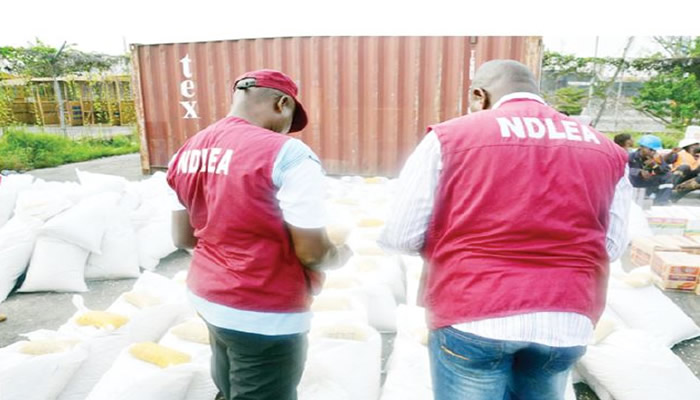

The National Drug Law Enforcement Agency (NDLEA) has raised fresh concerns over the growing internationalisation of Nigeria’s illicit drug trade, revealing that foreign criminal networks are increasingly attempting to establish production and trafficking bases in the country, including hidden laboratories located in forests in Ogun and Oyo states.
The disclosure was made on Thursday by the Director of Media and Advocacy and spokesman of the NDLEA, Femi Babafemi, during a radio conversation on Eagle FM.
Babafemi said the agency had moved beyond the traditional strategy of intercepting drugs at airports, seaports and major highways to directly targeting criminal networks at the points where they produce, finance and distribute illicit substances.
He identified recent operations involving what he described as collaboration between Nigerian and Mexican criminal networks in the establishment of industrial-scale methamphetamine laboratories in the forests of Ogun and Oyo states.
“We’ve seen recently the collaboration between the Nigerian-Mexican cartels trying to have methamphetamine in laboratories in the forests of Ogun and Oyo State,” he said, adding that another operation in Ebonyi State had resulted in arrests.
According to him, the agency would disclose further details of the Ebonyi operation after the completion of necessary investigative procedures.
The NDLEA spokesman said the development reflected the increasingly interconnected character of organised drug trafficking, with international criminal groups seeking new territories and alternative routes as enforcement pressure intensifies.
“They are trying to come in through whatever means they have to establish footholds, because it’s a global phenomenon, it’s a global challenge, so they are all networked, and that’s why we also, as law enforcement, we also network with our counterparts,” Babafemi said.
He explained that the agency was working closely with other Nigerian security agencies and international law-enforcement partners because the scale and sophistication of the drug trade could no longer be confronted by a single institution.
Babafemi said intelligence gathering and information sharing had consequently become central to the NDLEA’s operations, with the agency seeking to dismantle criminal organisations rather than merely confiscate individual consignments.
“We’re mopping up all of those floods of illicit substances across our communities and our streets, but beyond that, we’re taking this to them, right wherever they may be trying to do this,” he said.
He added that the agency was attacking the financial infrastructure supporting the drug trade by investigating the money, assets and operational networks behind trafficking activities.
“We are dismantling all their structures and disabling their capacity and capability, whether in terms of their financial backbone, or their instrumentalities,” he said.
Babafemi also disclosed that traffickers were changing their methods in response to increased surveillance and interceptions at Nigerian airports and seaports.
According to him, some international trafficking networks now move consignments through neighbouring countries before attempting to introduce them into Nigeria.
“These people already know that it’s difficult for them to come into Nigeria through airports or seaports,” he said.
He cited an NDLEA operation that dismantled a cartel allegedly using the Togo-Benin Republic-Nigeria corridor, describing the route as one that had contributed significantly to the movement of opioids into Nigeria.
Beyond physical routes, the agency is also extending its operations into the digital environment, where Babafemi said social media, cryptocurrency networks and the dark web were increasingly being used in the drug trade.
He disclosed that several NDLEA arrests had originated from intelligence gathered through social media platforms and said specialised teams were monitoring activities both on publicly accessible platforms and on the dark web.
“We are a modern front-line agency. Quite a number of our arrests have emanated from social media,” he said.
Babafemi said the NDLEA was also developing specialised expertise in financial investigation, asset tracing and the recovery of proceeds linked to narcotics trafficking and organised crime.
The agency, he added, was paying particular attention to social media influencers accused of promoting or glamorising illicit drug consumption.
“We’ve seen deep glorification of the glamorization of illicit substances, especially by social media influencers and that’s why a number of them had also been taken down,” he said.
The NDLEA is also engaging players in Nigeria’s entertainment industry in an effort to change messages that could encourage drug abuse.
Babafemi said the agency had established working relationships with the Actors Guild of Nigeria and the Performing Musicians Association of Nigeria as part of what he described as a combination of enforcement and public engagement.
“We have deployed what we call the stick and the carrot approach to address this,” he said, explaining that offenders would face enforcement action while influencers and industry stakeholders willing to cooperate would be engaged to reconsider the messages they project to the public.
The NDLEA spokesman described international drug cartels as highly organised and dangerous criminal enterprises, warning that the enormous financial rewards attached to narcotics trafficking made the groups particularly difficult to confront.
“Drug cartels anywhere in the world are very deadly,” Babafemi said, describing them as “merchants of death” because of the damage their activities inflict on society.
He said Nigeria’s drug threat was no longer limited to commonly known substances such as cannabis, cocaine and tramadol, as synthetic drugs, including methamphetamine and Captagon, were becoming increasingly significant concerns.
On cocaine trafficking, Babafemi explained that Nigeria was primarily a transit point rather than a production centre, with consignments originating in South America moving through Africa before being transported to other destinations.
He pointed to recent cocaine interceptions in Lagos and London as examples of the international nature of the trade.
According to him, the enormous value of narcotics on the international market continues to drive criminal groups to take greater risks.
He estimated that a kilogramme of methamphetamine or cocaine could sell for as much as $500,000 in some international markets.
Babafemi said the methamphetamine laboratory uncovered in Ogun State was particularly alarming because of its enormous production potential.
“What was to come out of the meth lab in the Ogun Forest was almost half a trillion Naira in value,” he said.
While intensifying enforcement, the NDLEA is also pursuing interventions aimed at addressing the economic conditions that encourage some communities to cultivate cannabis.
Babafemi disclosed that the agency had launched an Alternative Development Programme, with a pilot scheme in three communities in Ondo State where cannabis farmers were being encouraged to move into legitimate and sustainable livelihoods.
The communities include Ifon, around Owo, and Ilu-Abo and Eleyewo, around Akure.
He said the initiative was designed to help farmers move away from cannabis cultivation towards activities such as poultry, fishing, cash crops and food production.
According to him, the second phase of the programme was already being implemented, with the agency recording encouraging results.
“The outcomes have been very tremendous,” he said.
The NDLEA is equally strengthening its presence on Nigeria’s waterways as traffickers explore maritime routes to move narcotics.
Babafemi said the agency’s Marine Command had highly trained personnel who had received specialised training in countries including the United Kingdom, United States and Brazil.
He disclosed that officers had made seizures involving cocaine, methamphetamine and cannabis from vessels and on the high seas.
“Just last week, there were consignments of cocaine, meth, and cannabis that were seized on the high sea in Akwa Ibom State,” he said, adding that the consignment was allegedly being transported towards Cameroon.
The expanding threat has also prompted the NDLEA to strengthen the protection and operational capacity of its personnel.
Babafemi said officers were receiving specialised training and improved security equipment, while the agency had introduced enhanced insurance coverage for personnel against death and injuries sustained in the line of duty.
He disclosed that the NDLEA had acquired arms and ammunition, protective equipment, night-vision devices and bulletproof operational vehicles.
According to him, modern AK-47 rifles had also been introduced into the agency’s armoury for the first time in its history as part of measures to protect officers and secure NDLEA facilities against increasingly dangerous criminal groups.
“I also can tell you that all our personnel have been going through a lot of elite training across the world to equip them with the right skills to defend themselves,” he said.
Babafemi further disclosed that the agency was establishing residential accommodation for its personnel in strategic locations to reduce the risks faced by officers and their families after operations against drug traffickers.
He said facilities were being developed in Yola, Lagos, Abuja and Enugu, providing officers with secure environments away from communities where they may have conducted sensitive narcotics operations.
“For the first time in the history of the agency, we are having barracks in parts of the country, so that our officers can stay in a secure environment with their family without the fear of going back to the midst of the same community where they have gone to arrest drug traffickers or drug dealers,” he said.
The NDLEA is also relying on international partnerships as traffickers increasingly operate across national borders.
Babafemi said cooperation with foreign law-enforcement agencies had become indispensable to tracing the movement of drugs, following financial transactions and dismantling networks that operate across several countries.
He stressed that the agency’s objective was to ensure that forests, waterways, digital platforms and international corridors did not become safe havens for criminal organisations.
“We’re winning, as much as they want to continue to push this, we’re ensuring that they don’t have that space, the ungoverned space that they used to enjoy before now, that’s no longer the case,” he said.
The revelations come amid growing concern over the changing nature of Nigeria’s narcotics problem, with the NDLEA now confronting a drug economy that combines local distribution networks with international production, sophisticated financing, digital communication, maritime transportation and cross-border smuggling.











Leave a comment