



In a move framed as both symbolic and strategic, Dapo Abiodun, governor of Ogun State, this week distributed 40 brand-new SUVs to traditional rulers across the state.
The presentation, made at the Obas’ Complex in Abeokuta during a statutory meeting of the Ogun State Council of Obas, was described by the governor as an expression of appreciation for the monarchs’ role in sustaining peace, stability, and grassroots governance.
It was also positioned as a practical intervention—one that would enhance their mobility and enable them to better oversee their domains.
But beyond the optics of gratitude and governance, the gesture is raising a more difficult question: at what cost, and to what end?
While the Ogun State Government has not publicly disclosed the cost of the vehicles, market estimates offer a useful guide.
Comparable government-grade SUVs—such as the Toyota Prado or Fortuner—typically range between ₦80 million and ₦150 million per unit, depending on specifications. At that rate, the 40 vehicles could cost anywhere between ₦3.2 billion and ₦6 billion.
Even at the lower end of that estimate, the figure is significant—particularly in a state navigating the same economic headwinds affecting much of the country: inflation, rising cost of living, and infrastructure deficits.
The question, then, is not simply whether traditional rulers deserve support—but whether this is the most effective way to provide it. What Else Could ₦4 Billion Do?

Public spending is rarely judged in isolation; it is measured against alternatives.
At an estimated ₦4 billion: Dozens of primary healthcare centres could be built or upgraded, Hundreds of classrooms could be constructed or rehabilitated, Kilometres of rural roads—critical to local economies—could be paved.
Although, these comparisons do not invalidate the government’s decision. But they sharpen the conversation around trade-offs—a core principle in public finance.
Governor Abiodun has consistently promoted his administration’s “Building Our Future Together” agenda, with a strong emphasis on attracting investment and positioning Ogun as an economic hub.
At the same event, he warned communities in areas such as Yewa South, Ipokia, and Ijebu North against hostility toward investors, stressing that billions of dollars in potential investments depend on a peaceful and cooperative environment.
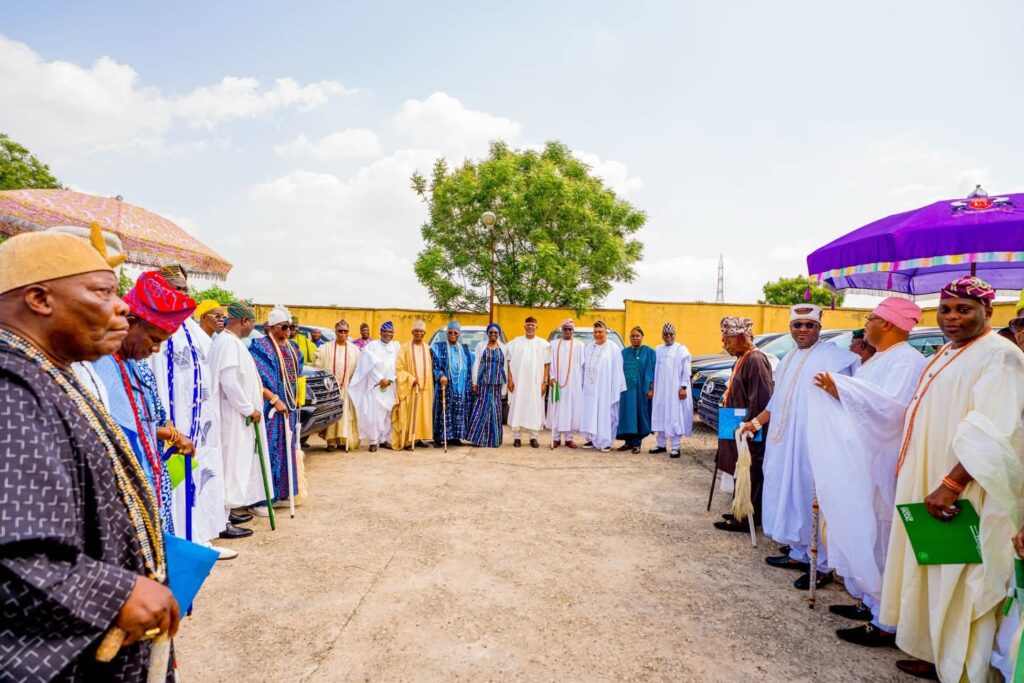
In that context, the SUVs can be interpreted as part of a broader strategy: strengthening traditional institutions that serve as intermediaries between government, investors, and local communities.
Yet, the move also raises a subtle contradiction.
If the state’s economic message is one of discipline, openness, and long-term planning, what signal does a multi-billion-naira expenditure on official vehicles send—especially to citizens bearing the brunt of economic reforms?
There is little dispute about the importance of traditional rulers in Nigeria’s governance ecosystem. They are custodians of culture, arbiters in local disputes, and, increasingly, partners in security and community engagement.
The chairman of the Ogun State Council of Obas, Kehinde Olugbenle, acknowledged this partnership, commending the administration’s developmental strides and reaffirming the council’s support for policies aimed at economic growth and stability.
But if the objective is to deepen their impact, some observers argue that mobility alone may not be enough.
Capacity building, institutional support, and clearer frameworks for community engagement may, in the long run, deliver more measurable outcomes than vehicles—no matter how new or well-intentioned.
Beyond the vehicle distribution, the governor used the occasion to address broader concerns—security, land management, and community cooperation.
He urged vigilance amid rising insecurity nationwide, warned against indiscriminate land allocation, and cautioned landlords against renting properties for criminal use.
“Our land is our oil,” he said, underscoring the economic value of responsible land administration.
These are substantive policy concerns. Yet, they also reinforce the central paradox of the moment: serious structural challenges being addressed alongside a highly visible—and costly—symbolic gesture.
Government spending is as much about perception as it is about policy.
To supporters, the SUVs represent a pragmatic investment in peace, governance, and the traditional institutions that help hold communities together.
To critics, they risk being seen as a misalignment of priorities—an elite-focused expenditure in a time that demands broader social investment.
Both views can coexist. But neither can be ignored.
Ultimately, the issue is not whether traditional rulers should be supported. It is whether the form that support takes aligns with the state’s most pressing needs.
As Ogun State seeks to position itself as a preferred destination for investors and a model of subnational development, every major spending decision becomes part of its story.
And in that story, the 40 SUVs may come to represent more than mobility.
They may come to represent a test—of priorities, of perception, and of the delicate balance between governance and optics.








Leave a comment