


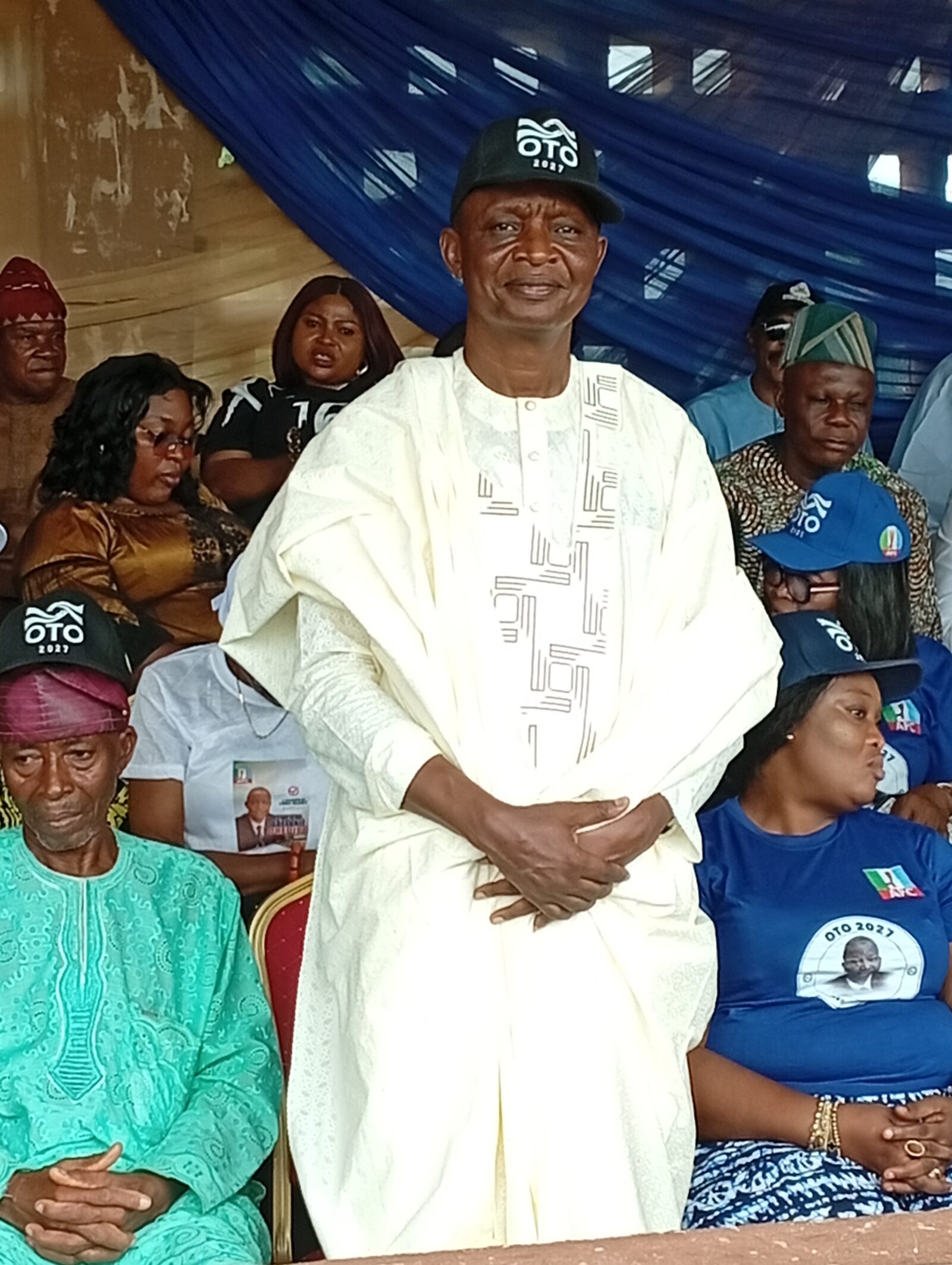
The emergence of Otunba Tunji Oredipe in the Ogun State governorship race has generated curiosity—and understandably so.
In a political landscape already shaped by established actors such as Solomon Adeola, late entries often invite scrutiny. Not out of cynicism, but out of necessity. Ogun voters have seen enough of politics to know that timing, messaging, and intent must always be carefully examined.
Otunba Tunji Oredipe has worked hard to position himself as a different kind of candidate—one who speaks the language of honesty and presents himself as standing apart from the transactional culture of Nigerian politics.
At his declaration event in Atan, he made a categorical assertion: “I did not pay anyone to come to here.” It was a statement clearly intended to reinforce his image as a principled outsider.
However, accounts and observations from subsequent campaign engagements appear to present a more complicated picture.
At various meetings with labour leaders and during grassroots mobilization efforts, there were instances where financial “tokens” were seen codedely distributed to stakeholders and attendees—practices often described within political circles as facilitation or mobilization support.
The issue here is not simply whether such practices occurred—given how normalized they are in Nigerian politics—but how they sit alongside the candidate’s public declarations.
For observers, this creates a difficult question: how should voters reconcile strong claims of non-inducement with campaign activities that may be perceived differently on the ground?
In a race where credibility is central, even the appearance of such contradictions can carry weight. A campaign built on integrity must not only make the right claims—it must also be seen, consistently, to align with them.
Early Signs from Campaign Structure
Campaigns are often the first real test of leadership capacity.
In Oredipe’s case, there have been observable signs—at least at the early stage—of coordination challenges: overlapping roles, evolving responsibilities, and a candidate visibly involved in operational details typically delegated to structured teams.
While some may interpret this as hands-on leadership, others may see it as an indication that the campaign’s internal systems are still developing.
Either way, it raises a broader question about readiness for the scale and complexity of state governance.
There is little doubt that Oredipe’s policy outline is ambitious. His multi-sector agenda—covering agriculture, technology, infrastructure, and youth development—aligns with the pressing needs of Ogun State.
Yet ambition alone is not enough.
For many observers, the key issue is whether these proposals are sufficiently grounded in clear, actionable pathways.
The language is compelling, but voters will likely look for more specificity—how these goals will be funded, sequenced, and delivered within existing political and economic realities.
Another issue that has quietly surfaced in political conversations is the question of long-term intent.
In Nigerian politics, it is not unusual for candidates without extensive structures to enter races, build visibility, and later align with stronger contenders. Whether fairly or not, this pattern shapes public perception.
Any suggestion—explicit or implied—that such an outcome is possible in this case naturally invites skepticism.
For voters, the priority is clarity: is this a fully committed bid for leadership, or part of a broader political strategy?
To be clear, Oredipe brings notable strengths to the table. His professional background, exposure, and engagement with grassroots communities are assets that deserve recognition.
But elections are not decided on credentials alone.
They are decided on trust—on the confidence that a candidate’s words align with actions, that structures are in place to support governance, and that the ambition to lead is matched by the preparedness to do so effectively.
The Responsibility of the Electorate
Ultimately, the responsibility lies with the people of Ogun State.
This moment calls not for dismissal, but for careful evaluation. Not for blind enthusiasm, but for critical engagement.
Voters must ask:
Are the candidate’s messages consistent with observed actions?
Is the campaign structure a reflection of governance readiness?
Are the policy proposals practical as well as aspirational?
Because beyond the speeches and the symbolism, what Ogun needs is leadership that is coherent, credible, and committed.
Anything less would simply repeat a cycle the electorate can no longer afford.










Leave a comment