



The Federal Government has clarified that although four Nigerians have lost their lives in South Africa in recent months, none of the deaths was directly linked to the ongoing xenophobic or Afrophobia protests targeting foreign nationals in the country.
Spokesperson of the Ministry of Foreign Affairs, Kimiebi Imomotimi Ebienfa, disclosed this during an interview on Frontline, a current affairs programme on Eagle 102.5 FM, Ilese-Ijebu, Ogun State, where he provided updates on the security situation, evacuation efforts, diplomatic engagements and measures being considered to protect Nigerian interests.

According to Ebienfa, investigations by the Nigerian High Commission in South Africa revealed that the deaths recorded involved separate incidents unrelated to the anti-foreigner protesters. He explained that three of the victims died following encounters with South African police officers, while another Nigerian, identified as Bijo, was allegedly killed by criminal elements.
While condemning the deaths, he stressed that Nigerians had not been directly targeted and killed by protesters as witnessed in some cases involving nationals of other African countries.
The ministry spokesman, however, acknowledged that Nigerians continue to face security threats in South Africa and disclosed that the Federal Government has intensified efforts to evacuate citizens willing to return home.
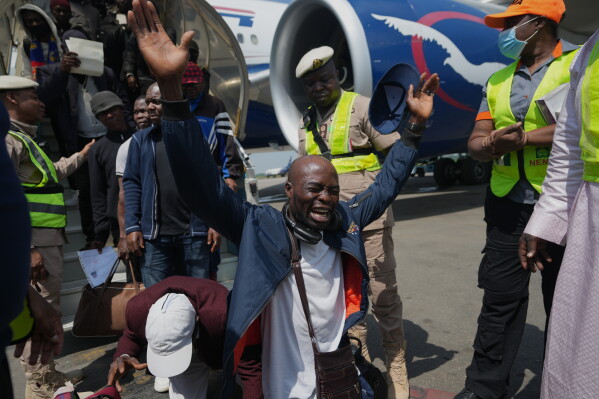
He revealed that President Bola Ahmed Tinubu had directed that no Nigerian willing to leave South Africa should be abandoned. So far, 859 Nigerians have been successfully evacuated, while additional flights have been approved to bring back more citizens.

Ebienfa explained that a scheduled evacuation flight was recently delayed after the Air Peace aircraft assigned to the operation developed technical faults, including damage to the cockpit windscreen. Despite the setback, he assured that the evacuation exercise remains ongoing and fully funded by the Federal Government.
He emphasized that no Nigerian is required to pay for the evacuation, noting that all approved flights have been financed by the government. He also disclosed that the Nigerian High Commission in Pretoria has been providing temporary accommodation, food and welfare support for displaced Nigerians awaiting evacuation.
In addition, a private Nigerian philanthropist reportedly sponsored the return of 66 Nigerians through commercial flights.
On the diplomatic front, Ebienfa said Nigeria has issued a strongly worded protest to the South African government, demanding stronger protection for foreigners and their businesses.
He disclosed that the Federal Government is compiling data on businesses abandoned by Nigerians fleeing South Africa with a view to seeking compensation from the South African authorities.
According to him, Nigerians who legally established businesses, paid taxes and contributed to the South African economy should not be forced to suffer losses arising from xenophobic hostility.
He noted that South African companies continue to operate freely in Nigeria without harassment, adding that the principle of reciprocity requires adequate protection for Nigerians living and investing in South Africa.
While acknowledging growing calls for tougher action against South Africa, Ebienfa said Nigeria remains committed to diplomacy but warned that stronger measures remain an option if the attacks and intimidation continue.
He recalled Nigeria’s historic role in supporting South Africa’s struggle against apartheid, noting that the country invested enormous resources in the liberation movement and therefore expects greater protection for its citizens.
The ministry spokesman also revealed that Nigeria is pushing for the issue to be discussed at the African Union level, arguing that xenophobic violence is a continental concern that requires collective action.
According to him, the Minister of State for Foreign Affairs, Ambassador Olaoluwa Enikanolaiye, has already raised the matter with members of the African Union Peace and Security Council, urging the continental body to consider a coordinated response before similar incidents spread to other African countries.
Beyond the South African crisis, Ebienfa disclosed that the Federal Government is considering reforms aimed at improving the protection of Nigerians abroad.
He said authorities are reviewing a system that would require Nigerians travelling overseas for employment to register with relevant government agencies before departure, similar to labour migration arrangements in countries such as the Philippines.
The proposed reform, he explained, would enable Nigerian missions abroad to better monitor citizens, verify employment opportunities and provide quicker assistance in emergencies.
He added that the ministry is also reviewing the welfare of Nigerians facing challenges in countries such as Kuwait and Ethiopia while pursuing agreements that could allow convicted Nigerians serving prison terms abroad to complete their sentences in Nigeria.
The ministry maintained that protecting Nigerians abroad remains a priority and assured citizens that government would continue to combine diplomacy, evacuation efforts and international engagement to safeguard their lives, businesses and investments.










Leave a comment