


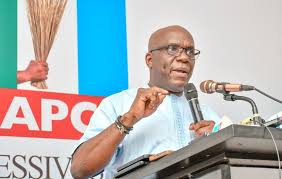
The All Progressives Congress (APC) has intensified its criticism of the African Democratic Congress (ADC), describing the opposition platform as a gathering of “power-driven individuals” rather than a credible political coalition, amid its ongoing leadership crisis.

Speaking during an appearance on Frontline, a current affairs programme on Eagle 102.5 FM, Ilese-Ijebu, Ogun State, APC National Publicity Secretary, Felix Morka, dismissed claims that the ruling party is interfering in ADC’s internal affairs, insisting that the crisis is self-inflicted.
According to him, the turmoil within the ADC reflects structural weaknesses and personal ambitions rather than any external manipulation.
“What we are witnessing is not a coalition but a convergence of individuals driven by personal ambition. There is nothing about the crisis within the ADC that has anything to do with the APC,” Morka said.
The controversy surrounding the ADC deepened following actions by the Independent National Electoral Commission (INEC), which suspended recognition of the party’s leadership in line with a court ruling directing all parties to maintain the status quo amid a leadership tussle.
The electoral body subsequently removed the names of key party officials from its records, effectively freezing the party’s activities pending final judicial determination.
However, ADC officials have rejected the move, alleging political interference aimed at weakening opposition platforms ahead of the 2027 general elections.
Reacting to the development, Morka argued that the ADC lacks the institutional coherence required of a serious political alliance, noting that the party is dominated by high-profile political figures pursuing individual ambitions rather than a shared ideological vision.
He referenced prominent politicians linked to the ADC, including Atiku Abubakar, Rotimi Amaechi, Peter Obi, Nasir El-Rufai, and Rauf Aregbesola, questioning the basis of what has been described as a coalition.
“This is not a merger of political parties with shared ideology. It is simply an assembly of individuals, each pursuing personal political interests. That is not what a coalition represents,” he said.
The APC spokesman traced the origins of the ADC crisis to internal disagreements that escalated into legal battles, particularly involving Nafiu Bala Gombe, whose claim to party leadership triggered court actions and institutional uncertainty.
According to Morka, the situation worsened due to procedural lapses and failure to adhere strictly to legal processes, resulting in adverse judicial outcomes now being framed as politically motivated.
He maintained that INEC’s actions were based solely on compliance with court orders and not influenced by any political party.
“INEC acted in accordance with the law. Attempting to drag the commission into partisan narratives only undermines public trust in democratic institutions,” he added.
Morka further criticised the track record of key figures within the ADC, arguing that many of them have held public office for decades without delivering meaningful progress.
He insisted that the current alignment within the ADC is driven more by a desire to regain political power than by a commitment to governance or national development.
“These are individuals who have been part of the system for years. Nigerians must ask what new ideas they are bringing to the table,” he said.
The APC spokesman urged opposition parties to take responsibility for internal challenges rather than attributing them to external forces, warning that persistent blame-shifting weakens democratic credibility.
He emphasised that effective political leadership requires discipline, adherence to due process, and respect for institutional frameworks.
“Nigeria’s democracy can only grow when political actors act responsibly. When parties fail internally, they must fix themselves rather than create conspiracy narratives,” he stated.
The ongoing dispute within the ADC continues to shape political conversations ahead of the 2027 elections, highlighting broader concerns about party cohesion, leadership credibility, and the strength of opposition platforms in Nigeria.
While the ADC maintains that it is being targeted, the APC insists that the crisis is a reflection of internal dysfunction, reinforcing the growing divide between the ruling party and opposition forces.







Leave a comment