


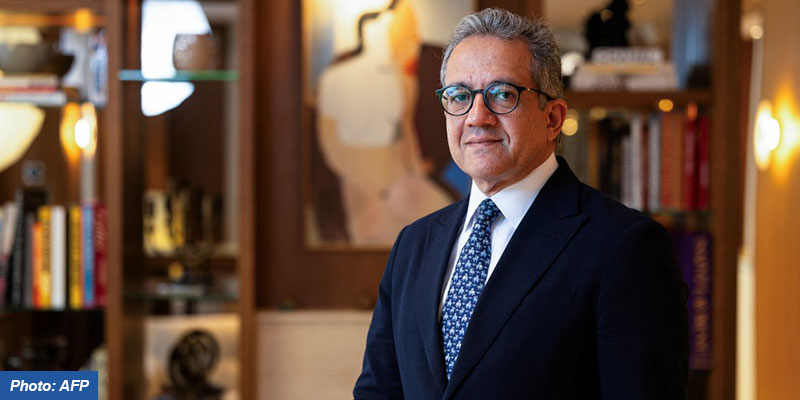
The Director-General of the United Nations Educational, Scientific and Cultural Organization (UNESCO), Khalid El Ehany, has reaffirmed the agency’s commitment to institutional reform and stronger global cooperation following high-level meetings with the leadership of UNESCO’s governing bodies ahead of the organization’s 80th anniversary celebrations.
In a statement shared on his official social media platform on Wednesday, El Ehany disclosed that he met with the President of UNESCO’s General Conference, Khondker M. Talha, and the Chairperson of the Executive Board, Nasser Bin Hamad Al Hinzab, to discuss strategic priorities aimed at strengthening the organization’s relevance and effectiveness in a rapidly evolving global environment.

According to the Director-General, sustained dialogue among UNESCO’s leadership remains critical to advancing shared goals and ensuring coordinated action on key international challenges affecting education, science, culture, communication, and sustainable development.
A major focus of the discussions was UNESCO80, a landmark initiative marking the organization’s forthcoming 80th anniversary and serving as a platform for reflection, reform, and future planning.
The leaders also reviewed preparations for the launch of the Open-Ended Working Group on Pillar 2 of the UNESCO80 agenda, an initiative expected to examine how the organization can modernize its structures, improve delivery mechanisms, and respond more effectively to emerging global realities.
Observers say the UNESCO80 framework represents one of the most significant institutional reviews undertaken by the organization in recent years, as member states seek to position UNESCO for greater impact in an era shaped by technological disruption, geopolitical shifts, climate challenges, educational inequalities, and cultural transformation.
During the meeting, participants exchanged views on strategies for increasing UNESCO’s effectiveness and ensuring that its programmes remain responsive to the needs of member states and communities around the world.
The discussions also explored ways to strengthen collaboration among governing bodies, improve institutional efficiency, and deepen UNESCO’s contribution to international peace, sustainable development, and intercultural dialogue.
According to El Ehany, the objective is to ensure that UNESCO remains a people-centred institution capable of delivering meaningful solutions to contemporary global challenges.
“We exchanged views on how UNESCO can further enhance its impact, relevance, and effectiveness in a rapidly changing world,” he stated.
Founded in 1945 following the Second World War, UNESCO has played a central role in promoting education, preserving cultural heritage, advancing scientific cooperation, defending press freedom, and fostering international understanding among nations.
As the organization approaches its 80th anniversary, analysts believe it faces increasing pressure to adapt to new global realities while maintaining its historic mission of building peace through education, science, culture, and communication.
The ongoing reform conversations are therefore viewed as part of a broader effort to strengthen multilateral cooperation and ensure that UNESCO remains equipped to address the complex challenges of the 21st century.
With the launch of the Open-Ended Working Group expected to begin shortly, stakeholders say the coming months could shape important decisions about the future direction of one of the world’s most influential international organizations.





Leave a comment