


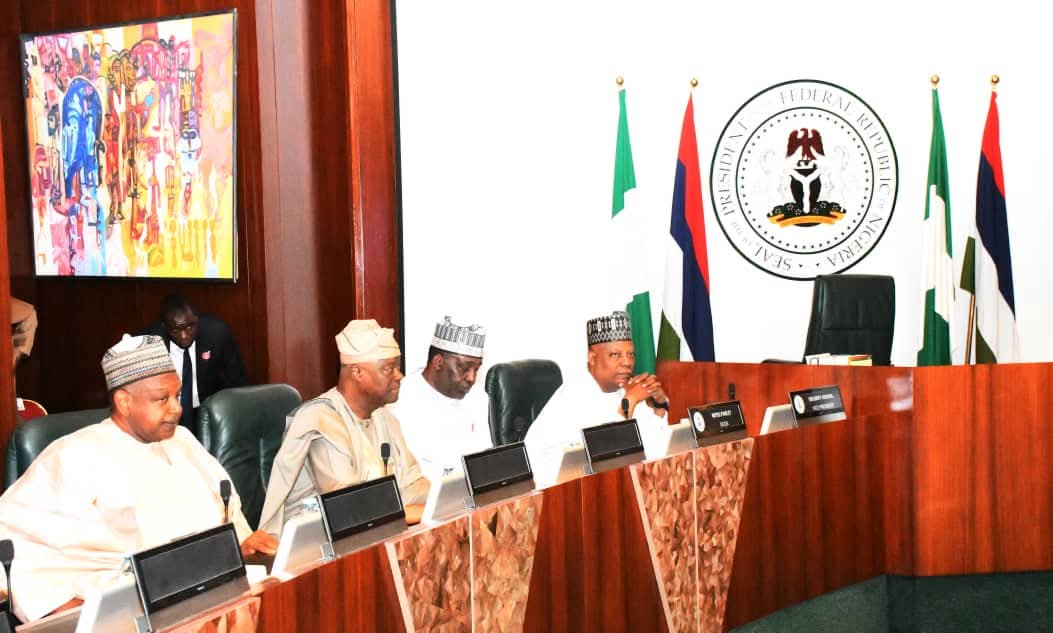
President Bola Ahmed Tinubu has unveiled a comprehensive security and economic framework aimed at harnessing Nigeria’s vast marine and aquatic resources under the blue economy, identifying it as a key sector for national transformation.
Speaking during a Presidential Parley with participants of Senior Executive Course 47 of the National Institute for Policy and Strategic Studies (NIPSS) at the Presidential Villa, Abuja, the President, represented by Vice President Kashim Shettima, said the administration is committed to converting Nigeria’s maritime potential into a major driver of economic diversification, job creation, and long-term prosperity.

“The blue economy offers a strategic pathway for diversifying our revenue base, creating sustainable employment, and revitalising the ecosystems that sustain national development. If properly harnessed, this sector could become an anchor of shared prosperity for generations,” he said.
President Tinubu welcomed the findings of the NIPSS study on Blue Economy and Sustainable Development in Nigeria, describing it as a timely resource that outlines opportunities, challenges, and policies for reform. He praised the institute for its analytical rigour and patriotic commitment to national development.
Highlighting Nigeria’s 853-kilometre coastline, rich fisheries, inland waterways, and strategic Gulf of Guinea location, the President said the administration is prioritising aquaculture expansion, port and maritime corridor modernisation, coastal tourism, marine biotechnology, and renewable ocean energy.

The President also reiterated the importance of a secure maritime environment, acknowledging progress through the Deep Blue Project but warning that piracy, oil theft, illegal fishing, smuggling, and kidnapping remain threats to national revenues and investor confidence.
In a bid to strengthen national security and economic planning, President Tinubu assigned NIPSS an expanded mandate to conduct a nationwide security diagnostic and provide actionable recommendations for reforming Nigeria’s security architecture. “The policy paper shall be submitted to my office within an agreed timeline and will receive the utmost attention,” he assured.
The NIPSS report highlighted challenges in governance, institutional coordination, and infrastructure gaps, while emphasising opportunities in fisheries, aquaculture, and maritime investments. It recommended a national fisheries expansion programme to increase production from 1.2 metric tonnes to 10 metric tonnes within two years, establishment of a marine and blue economy financing framework, harmonisation of legal and policy structures, and development of skills and job creation initiatives.
Director-General of NIPSS, Prof. Ayo Omotayo, thanked President Tinubu for the support provided to the institute and commended the Minister of Finance, Wale Edun, for funding the Senior Executive Course 47, which conducted the study across several Nigerian states and 14 foreign countries.
Governor and policy experts hailed the framework as a forward-looking initiative with the potential to significantly enhance Nigeria’s economic resilience, maritime security, and international competitiveness.








Leave a comment