


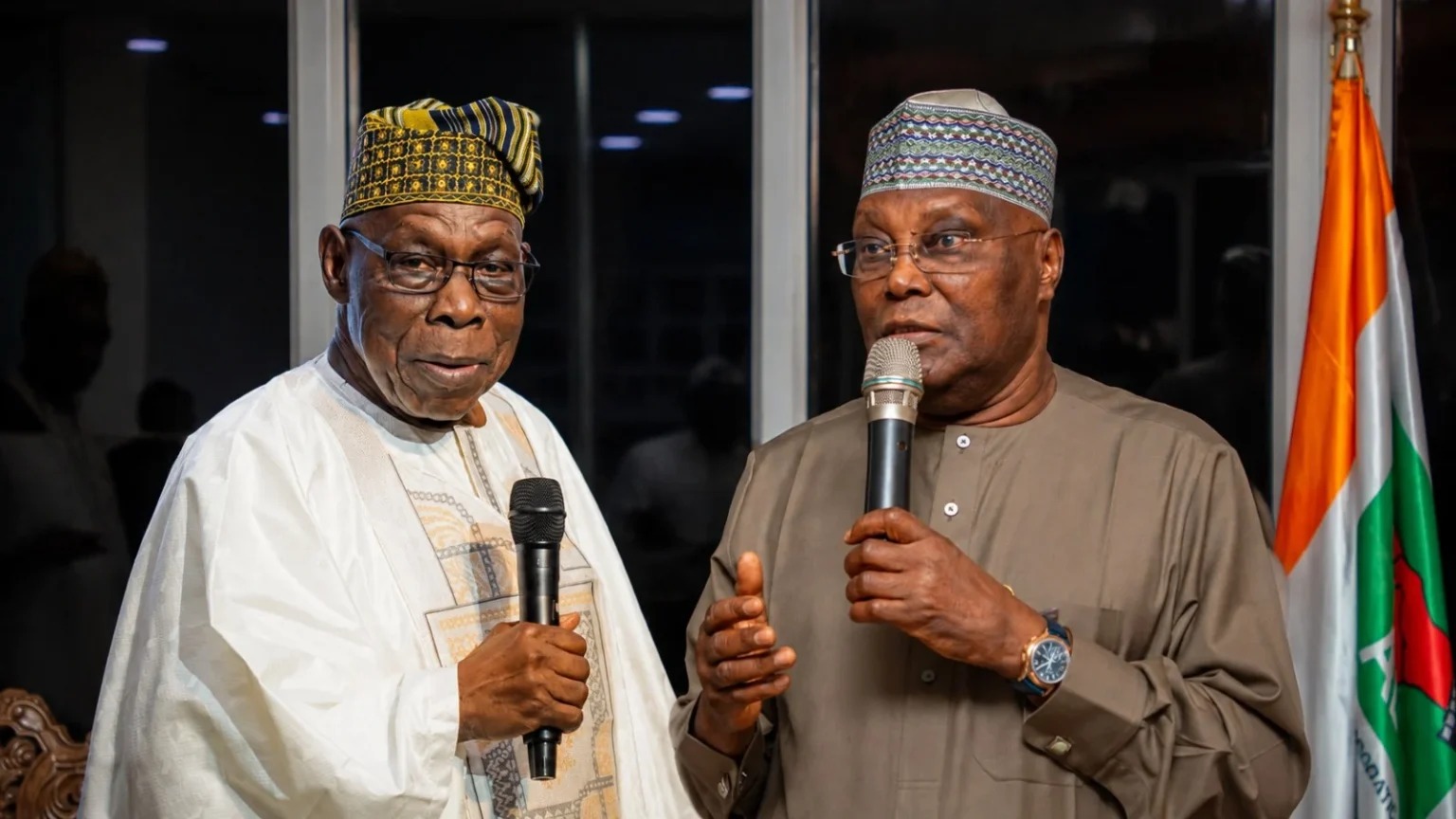
 The lingering disagreement between former President Olusegun Obasanjo and former Vice President Atiku Abubakar is rooted in political differences rather than personal animosity, Atiku’s Senior Political Assistant, Demola Olarewaju, has said.
Olarewaju made the submission on Monday during an interview on Frontline, a current affairs programme on Eagle 102.5 FM, Ilese-Ijebu, Ogun State, where he appeared alongside the Executive Director of the Centre for Responsive Governance (CRG), Ayodeji Ologun.
The two guests also dismissed the suggestion that the long-running disagreement between the two former leaders should be interpreted as a personal feud, arguing that political interests and competing visions have played a major role in the relationship.

The latest exchange is part of a long-running political disagreement between Obasanjo and Atiku that dates back to their years in office between 1999 and 2007.
The relationship, which began as a powerful political partnership that helped shape Nigeria’s Fourth Republic, became increasingly strained towards the end of their tenure.
The dispute has resurfaced with renewed intensity following recent comments by Obasanjo, who described his decision to choose Atiku as his running mate in 1999 as the “biggest mistake” of his political life.
The former president also alleged that Atiku was involved in an attempt to impeach him in 2003, claiming that the former vice president paid N5 million to the late Speaker of the House of Representatives, Ghali Umar Na’Abba, to initiate the process.
Atiku, through his media aides, rejected the allegations, describing them as part of what his camp considers a longstanding attempt to distort the history of their relationship and political events during the Obasanjo administration.
The former vice president has also maintained that his disagreement with Obasanjo was substantially connected to his refusal to support the former president’s reported ambition to extend his tenure beyond the constitutionally permitted terms.
Atiku has argued that his position was based on his commitment to the Constitution and Nigeria’s democratic principles rather than personal disloyalty.
He also denied the alleged payment to Na’Abba and questioned the reliance on a deceased former lawmaker who could no longer respond to the allegation.
Atiku’s camp has further pointed to accounts attributed to political figures who were active during the period, including former House Chief Whip Abubakar Bawa Bwari and former Abia State Governor Orji Uzor Kalu, in challenging aspects of Obasanjo’s account.
The renewed disagreement comes at a time when Atiku remains active in opposition politics ahead of the 2027 presidential election.

Olarewaju said Atiku continues to hold Obasanjo in high regard despite their political differences, arguing that the former vice president has not allowed the disagreement to become a personal vendetta.
“The relationship between the former President Obasanjo and Atiku, in my view as a Nigerian who witnessed the administration and the post-administration, is the fact that they do not seem to have a personal issue. It is clear from how Atiku holds Obasanjo in high esteem,” he said.
He, however, alleged that the fundamental disagreement is political and claimed that Obasanjo does not want Atiku to become president of Nigeria.
“The issue between them is political and, for reasons best known to Obasanjo, it is very clear and obvious that he does not want Atiku Abubakar to ever be President of the Federal Republic,” Olarewaju said.
He also questioned what he described as an apparent belief by Obasanjo that subsequent leaders have been unable to match his achievements in office.
“I think another thing that has become very clear is his instability about the opinion that Obasanjo holds that nobody can meet up with his achievement and nobody can govern Nigeria better than him,” he said.
Olarewaju further described Obasanjo’s political activities since leaving office in 2007 as part of what he called a “journey of redemption”, suggesting that some of the former president’s political interventions over the years should also be examined within the context of his relationship with the Yoruba people and his broader political history.
He referenced Obasanjo’s role during the Nigerian Civil War and argued that the former president’s subsequent political interventions could partly be viewed against the background of his relationship with the South-West.
Olarewaju also compared Obasanjo’s reactions to successive administrations, claiming that the former president had been more critical of the administrations of former Presidents Goodluck Jonathan and Muhammadu Buhari than he has been of President Bola Ahmed Tinubu’s government.
He further downplayed Obasanjo’s ability to determine electoral outcomes in the South-West, particularly with regard to Atiku’s political ambitions.
“We are determined that this opposition won’t affect Atiku’s campaign,” he said.
On concerns over Atiku’s age, with the former vice president now 79, Olarewaju argued that the national conversation should go beyond the age of individual political aspirants and focus on the structural problems confronting Nigeria.
He identified what he described as excessive centralisation of political and economic powers in Abuja as one of the country’s fundamental challenges.
“One of the biggest problems that we have in Nigeria is that the Federal Republic of Nigeria is not actually federal. That’s why we have so much power concentrated on Abuja, and over time it has continued to be a problem,” he said.
Olarewaju also challenged the tendency to explain Nigeria’s challenges simply through the alleged corruption or incompetence of individual leaders.
He argued that changing the occupant of the presidency without addressing the structural weaknesses within the country’s governance system would not fundamentally resolve Nigeria’s problems.
“Anybody you put there, unless they go back to fixing the fundamentals, they will continue; we will continue to have the same problem,” he said.
Also speaking, Ologun backed Olarewaju’s position, arguing that Obasanjo’s current posture towards Atiku represents a significant departure from some of his earlier comments about the former vice president.
Ologun recalled that in the build-up to the 2019 presidential election, Obasanjo had spoken positively about Atiku and acknowledged his understanding of governance and national affairs.
“In 2019, Obasanjo spoke well about Atiku, saying that he knows well about running the affairs of the country,” Ologun said.
He noted that Atiku and Obasanjo had worked closely during their years in government, with Atiku playing a significant role as vice president in the administration.
Ologun argued that Obasanjo’s subsequent opposition to Atiku’s presidential ambitions, including during the 2023 election cycle, raises questions about the reasons for the change in his political position.
“But no matter what happens, we want Nigerians to understand the truth that Atiku never did a thing to Obasanjo,” he said.
“Obasanjo is attacking Atiku for political reasons; he doesn’t want him to become the president,” Ologun added.
Ologun also defended Atiku against concerns about his age, describing him as one of Nigeria’s most experienced political figures with extensive knowledge of the country’s political terrain.
“It’s undisputable that former President Atiku Abubakar remains one of the brightest and one of the most blessed of all the politicians that this country has produced in recent times,” he said.
He further described Atiku as a politician with a broad national outlook and praised what he described as the former vice president’s investments in younger Nigerians and commitment to youth development.
The renewed exchange has once again brought one of Nigeria’s most enduring political relationships into the national spotlight.
Obasanjo and Atiku once formed a formidable political partnership at the beginning of the Fourth Republic, with their joint ticket winning the 1999 presidential election and securing re-election in 2003.
However, disagreements over governance, political succession and the direction of the country eventually transformed the relationship into one of Nigeria’s most closely watched political rivalries.
Their differences have resurfaced repeatedly during subsequent election cycles, with both camps offering competing interpretations of events surrounding their years in government and their political relationship.
Atiku’s continued participation in opposition politics ahead of the 2027 presidential election means the relationship between the two former leaders is likely to remain part of Nigeria’s political discourse.
For now, Atiku’s camp insists that the disagreement should not be reduced to personal animosity, maintaining that political interests, competing ambitions and fundamental differences over Nigeria’s political direction remain at the heart of the dispute.
Whether the two former leaders will eventually reconcile remains uncertain, but their latest exchange demonstrates that the political chapter connecting Obasanjo and Atiku is far from closed.




Leave a comment