


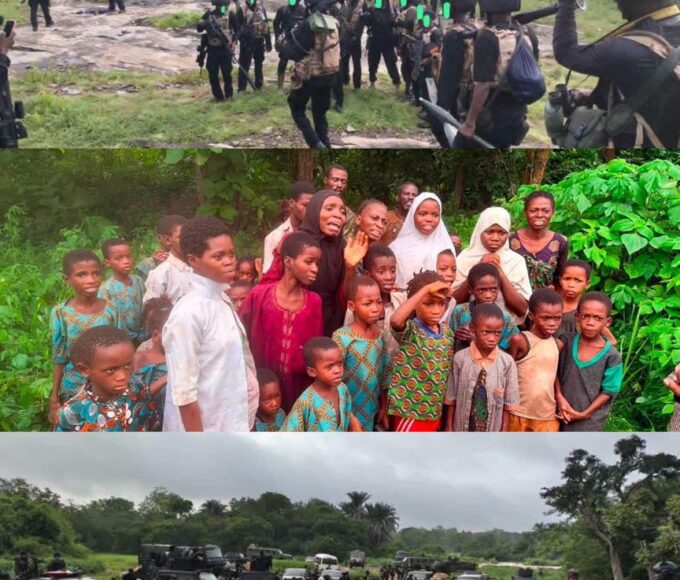
Retired Major General Ishola Williams has thrown his weight behind Oyo State Governor Seyi Makinde’s call for an independent international investigation into the abduction and eventual rescue of pupils and teachers kidnapped in Oriire Local Government Area, arguing that the demand is justified by past precedents and lingering questions surrounding the incident.
Williams made the remarks during an interview on Frontline, a current affairs programme on Eagle 102.5 FM, Ilese-Ijebu, while reacting to the controversy generated by Governor Makinde’s request for an independent probe into the circumstances that led to the kidnapping and the subsequent rescue operation.

The retired military officer said the governor’s position was neither unusual nor politically motivated, recalling that international organisations were invited to scrutinise the abduction of the Chibok schoolgirls during the administration of former President Goodluck Jonathan.
According to him, those who demanded international involvement during the Chibok crisis cannot now fault Makinde for seeking similar scrutiny.
“Makinde is right in making that call. During the Chibok girls’ abduction, international organisations were invited and there was pressure from all quarters for external intervention. What comes around turns around,” Williams said.
While supporting the governor’s demand for transparency, the retired general noted that a state government lacks the constitutional authority to formally invite the United Nations to investigate security matters.
He explained that such requests can only be initiated by the Federal Government through diplomatic channels, suggesting that reputable international organisations such as Amnesty International could instead conduct an independent review of the incident.
“Diplomatically, a governor cannot invite the United Nations. That responsibility belongs to the Federal Government. However, independent organisations with global credibility can be engaged to carry out a thorough investigation,” he stated.
Beyond the debate over an international probe, Williams raised concerns about what he described as glaring intelligence failures that allowed armed kidnappers to abduct dozens of pupils and teachers without prior detection.
He questioned the effectiveness of security structures within Oyo State, including the Ministry of Home Affairs, the Amotekun Corps and local intelligence networks.
The retired general argued that the scale of the operation suggested that warning signs were either missed or ignored.
“Is the Ministry of Home Affairs functioning effectively? Is Amotekun’s intelligence unit doing its job? These are questions that must be answered because such a large-scale operation should not have happened unnoticed,” he said.
Williams maintained that accountability should not stop with the kidnappers, insisting that security officials and community leaders should also be examined for possible lapses.

He argued that grassroots intelligence mechanisms appeared to have failed completely, allowing criminals to move freely and execute the operation.
“How could armed men enter a community, abduct so many children and disappear into the forest without anyone noticing? Without Amotekun knowing? Without community leaders being aware?” he queried.
The former military officer went further to suggest that local collaborators may have assisted the kidnappers, insisting that criminal groups rarely succeed without support from people within affected communities.
“Those kidnappers could not have operated successfully without assistance from members of the community. That possibility must be investigated thoroughly,” he stated.
Williams also expressed reservations about the official narrative surrounding the rescue operation, saying more details should be released to the public to allow independent security experts assess the methods used and draw lessons for future operations.
According to him, transparency would help strengthen public confidence while providing useful insights for tackling similar incidents across the country.
The retired general used the opportunity to renew his long-standing advocacy for state policing and a decentralised security structure, arguing that Nigeria’s centralised policing system has become increasingly ineffective in responding to local security threats.

He said governors, who are constitutionally designated as chief security officers of their states, should be given greater operational control over security resources while receiving strategic support from federal agencies.
Williams also called for the creation of a specialised federal criminal intelligence and investigation agency that would focus on intelligence gathering and support state-level security operations.
“We need a strong federal crime intelligence agency working with local security structures. That is what should have been supporting Amotekun in Oyo State,” he said.
The retired general further questioned the enormous resources reportedly deployed to secure the release of the Oriire victims, arguing that if similar levels of intelligence and operational coordination were consistently applied in insurgency-prone regions, Nigeria could make greater progress against terrorism and banditry.
He particularly urged security agencies to intensify efforts in the North-East, where insurgency continues to pose a major national security challenge.
Williams concluded by calling for stricter accountability among community leaders, warning that traditional rulers and local authorities should no longer be allowed to distance themselves from recurring criminal activities within their domains.
“Community leaders must be held accountable when criminals repeatedly operate within their areas. Some communities may be benefiting from these criminal activities, and that must stop,” he said.




Leave a comment