


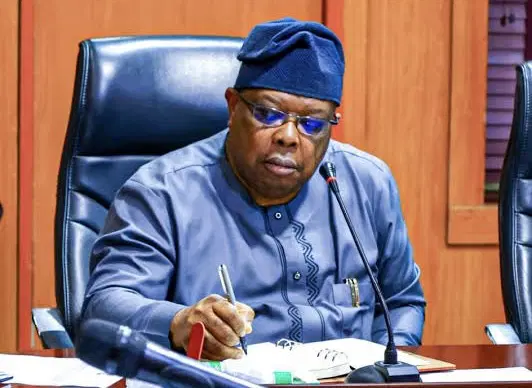
The Federal Government has settled ₦1.23 trillion out of the ₦3.3 trillion approved for the payment of verified legacy debts owed to electricity generation companies, the Minister of Power, Joseph Olasunkanmi Tegbe, has disclosed.
Tegbe made this known on Friday, November 13, during an interactive luncheon with senior media editors in Lagos, where he outlined the government’s efforts to address longstanding financial and infrastructure challenges in Nigeria’s electricity sector.
According to the minister, the debt settlement is part of the Presidential Power Sector Debt Reduction Programme approved by President Bola Tinubu to address unpaid obligations that have weakened the finances of electricity generation companies and affected the stability of the power supply chain.
The legacy debts accumulated over several years and have been identified as a major constraint on the ability of generation companies to meet operational expenses, pay gas suppliers and invest in additional electricity generation capacity.
The Federal Government’s broader settlement plan followed a verification exercise that established ₦3.3 trillion as the agreed amount for resolving the outstanding obligations. The programme is designed to restore liquidity and confidence across the electricity value chain.
Tegbe also disclosed that more than 2.8 million electricity customers had been metered between 2023 and October 2026 under the Presidential Metering Initiative.
He said the intervention was intended to address metering gaps, improve billing practices and strengthen revenue collection across the electricity distribution system.
On transmission infrastructure, the minister reported that recently commissioned substations and equipment had added more than 1,300 megavolt-amperes (MVA) to the country’s transmission capacity.
The improvements covered locations including Apapa, Ijora and Ikeja in Lagos, as well as Kumbotoso, Dankata, Mashi, Dan-Agundi, Biliri and Walalambe.
Tegbe further disclosed that construction was underway on a new National Grid Control Centre in Osogbo, Osun State, to replace the existing facility, which is more than 60 years old.
He said the government was also working towards expanding electricity generation capacity to 10,000 megawatts, while identifying the Lagos-Ogun, Benin-Enugu-Port Harcourt and Abuja-Kaduna-Kano corridors as priority energy zones for infrastructure development.
The Lagos-Ogun axis and Abuja franchise area, which together account for more than half of national electricity demand, have been identified as proposed pilot locations for 24-hour energy zones. The initiative, however, is subject to technical readiness and commercial viability.
The minister acknowledged that Nigerians remained frustrated by unreliable electricity supply, noting that the sector continued to face interconnected challenges, including inadequate gas supply, ageing infrastructure, vandalism, transmission limitations, insufficient metering and commercial difficulties.
He said addressing these problems required sustained reforms, investment and coordination across the electricity value chain rather than isolated interventions.
On infrastructure protection, Tegbe said the Federal Government had approved a coordinated anti-vandalism campaign involving security agencies, alongside stronger legal measures to safeguard critical electricity facilities.
He also called for stronger collaboration between the government and the media, stressing the importance of factual reporting, professional scrutiny and transparent communication about developments in the power sector.
The minister assured Nigerians that the government would continue to provide updates on electricity interventions, while welcoming constructive criticism from stakeholders.
He maintained that the ultimate test of the administration’s efforts would be measurable improvements in electricity supply to homes, businesses and industries, rather than policy announcements or increases in installed capacity alone.







Leave a comment