


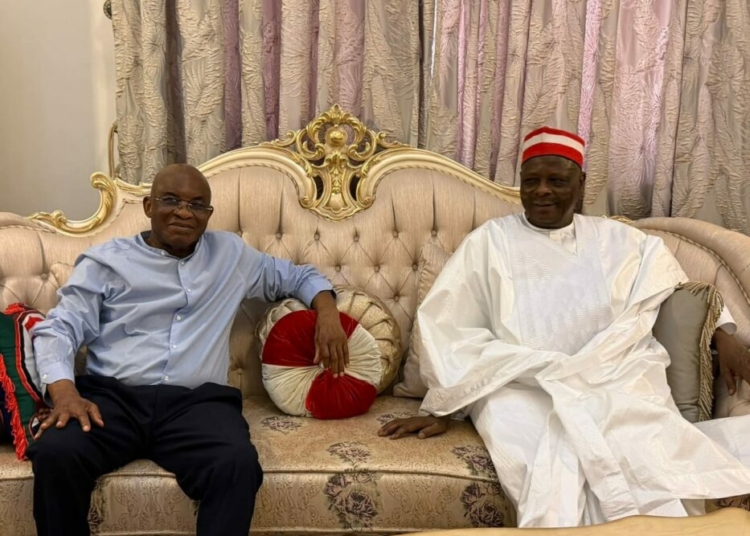
The National Secretary of the New Nigeria People’s Party, Dipo Olayoku, has described the resignation of former Kano State governor, Rabiu Musa Kwankwaso, as a predictable development, attributing it to longstanding internal disagreements within the party.
Kwankwaso, a key figure in the party’s recent rise, formally exited the NNPP on March 29, 2026, and is expected to align with the African Democratic Congress, in what analysts see as a major political realignment ahead of the 2027 general elections.
Speaking during an interview on Frontline, a current affairs programme on Eagle FM, Ilese-Ijebu, Ogun State, Olayoku said the development had been anticipated by the party’s leadership due to widening ideological and strategic differences.
“It didn’t come as a surprise. As a political party, we had already begun to observe realignments, and individuals naturally assess where their interests are best protected in a dynamic system like Nigeria’s,” he said.
Olayoku explained that disagreements over coalition politics, governance philosophy, and the party’s long-term direction had made continued collaboration increasingly difficult.

According to him, the internal debates—particularly on whether to align with other political blocs or maintain an independent opposition stance—created deep divisions among stakeholders.
“There were clear differences in vision. These were not just tactical disagreements but fundamental issues about political identity and direction,” he noted.
He added that earlier defections at the state level further exposed structural tensions within the party, setting the stage for Kwankwaso’s eventual exit.
A major concern following the defection is the likely movement of supporters of the influential Kwankwasiyya political structure.
Olayoku described the movement as highly centralized around Kwankwaso’s leadership, noting that its members are expected to follow him to his new political platform.
“Anywhere he goes, his followers go. He has built that structure over the years, so naturally, his exit will have an impact on the party,” he said.
The development is already sending ripples across Nigeria’s political landscape, especially as millions of supporters are reportedly being mobilized to register with the ADC nationwide.
Olayoku also pointed to ideological differences between Kwankwaso and other party stakeholders as a key factor in the split.
He suggested that disagreements over governance approach and political alignment made coexistence untenable.
“There was a clear divergence in thinking. While some members were considering alliances for strategic reasons, Kwankwaso maintained a different ideological position,” he explained.
NNPP’s Survival and Future
Despite the high-profile exit, Olayoku insisted that the NNPP remains structurally intact and capable of rebuilding.
He emphasized that the party predates Kwankwaso’s involvement and is not dependent on any single individual for survival.
“NNPP has existed for over two decades. While Kwankwaso elevated the party’s national profile, the party will continue to grow beyond this phase,” he stated.
He acknowledged, however, that Kwankwaso played a significant role in the party’s success during the 2023 general elections, when it recorded unprecedented victories across multiple levels.
Opposition Realignment Ahead of 2027
Kwankwaso’s move is widely seen as part of a broader effort to consolidate opposition forces ahead of the next general elections. High-profile political figures, including David Mark and Rotimi Amaechi, are reportedly involved in the unfolding coalition dynamics.
Meanwhile, the NNPP leadership has signaled its willingness to explore alliances, with indications that the party may still collaborate with the ADC in future electoral contests.
For Olayoku, the current situation represents both a challenge and an opportunity for the party to redefine itself.
“Political parties are built on voluntary association. People will leave, and new people will join. Now that NNPP has gained national recognition, it will continue to attract new members,” he said.
As Nigeria’s political landscape continues to evolve ahead of 2027, the NNPP faces what many observers describe as its most significant test yet—rebuilding its identity and sustaining relevance in a rapidly shifting opposition space.





Leave a comment