


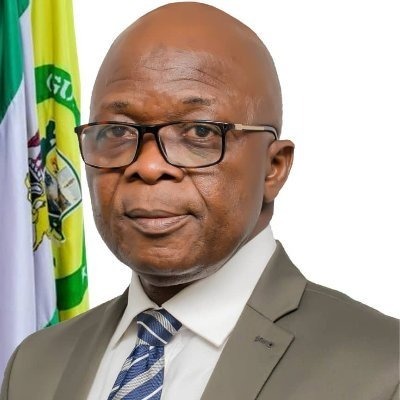
The Ogun State Government has assured parents and residents that learning activities remain uninterrupted in schools affected by recent methane gas emissions in parts of Ijebu-Ode, stating that students have been relocated to safe areas within their school premises while investigations into the environmental incident continue.
The Commissioner for Education, Science and Technology, Prof. Abayomi Arigbabu, gave the assurance during an interview on Frontline, a current affairs programme on Eagle 102.5 FM, Ilese-Ijebu, saying the government has adopted a comprehensive approach to protect learners, sustain academic activities and address wider challenges confronting the education sector.
Arigbabu explained that following concerns raised by parents over the methane emissions, the government initially directed learners to remain at home while safety assessments were carried out. However, arrangements were made for Senior Secondary School Three (SS3) students writing the West African Senior School Certificate Examination (WASSCE) to continue their examinations in alternative schools.
According to him, students of Anglican Girls Grammar School were temporarily relocated to Adeola Odutola College, while candidates from Our Lady of Apostles Secondary School sat for their examinations at Ijebu Muslim College.
“When parents raised concerns, we listened and put measures in place that would give them confidence. The SS3 students writing WAEC examinations were relocated to other schools. Now that they have completed their examinations, all learners have resumed and are receiving lessons in safe sections of their schools,” he said.
The commissioner disclosed that investigations showed the methane emissions were concentrated in specific portions of the affected schools rather than across the entire campuses, making it possible to isolate the affected zones while academic activities continue elsewhere.
“Because the emission is concentrated in particular locations, we have cordoned off those areas and moved learners to safer places within the schools. The odour may still be noticed lightly across parts of the town, but it is not at dangerous levels in those learning areas,” he explained.
Arigbabu stressed that the methane incident should not be viewed solely as a school problem, noting that evidence suggests it is a wider environmental issue affecting parts of the Ijebu-Ode community.
“It is about the whole town. Government is looking at it holistically. The intention is to identify the source, determine the extent of the problem and implement measures that will permanently address it. It is a natural occurrence and not a terrorist attack as some people have speculated,” he said.
He expressed optimism that the approaching end of the school term and the subsequent eight-week vacation would provide sufficient time for experts and relevant agencies to conclude investigations and implement long-term safety measures before schools resume for a new academic session.
The commissioner added that the state government is also prepared to deploy its artificial intelligence-powered learning platform to ensure continuity of education should physical classroom learning become temporarily impossible.
Beyond the methane situation, Arigbabu reaffirmed the government’s ban on graduation ceremonies for non-terminal classes in both public and private schools, warning that defaulting institutions risk sanctions.
He explained that the policy was introduced in response to numerous complaints from parents about excessive levies, graduation fees and financial pressures associated with unnecessary ceremonies for pupils merely progressing to the next class.

“The directive applies to all approved schools in Ogun State. We are the regulators and schools are expected to comply. If any institution violates the directive and is found culpable, appropriate sanctions will follow,” he said.
Reviewing the performance of the education sector under Governor Dapo Abiodun’s administration, the commissioner said the government launched an ambitious Education Revitalisation Agenda immediately after assuming office, focusing on curriculum reform, school management, technology, infrastructure, funding and student welfare.
He highlighted the establishment of 86 flagship schools across the state, the introduction of smart classrooms in over 236 schools and extensive rehabilitation of educational infrastructure under the Ogun Rehab initiative.
“Go around our schools and you will see the transformation. New classrooms have been built, old structures renovated and learning environments significantly improved. The yellow-roof projects are visible evidence of government investment in education,” he said.
According to Arigbabu, the administration has also improved teachers’ welfare by ensuring prompt salary payments and clearing promotion backlogs inherited from previous years.
“The promotion backlog dating back to 2016 has largely been addressed. Teachers now receive their salaries regularly and welfare has improved significantly,” he noted.
The commissioner revealed that Ogun’s education reforms are attracting national attention, with at least five states indicating interest in studying some of the initiatives introduced by the government.
He particularly highlighted Ogun’s leadership in educational technology, noting that the state’s learner identification number system has now been adopted nationally.
“We started the learner identification number initiative about five years ago and it has now become a national model. We have also introduced OgunLearn, the country’s first AI-powered teaching and learning platform, which is transforming classroom instruction and learning outcomes,” he said.
Arigbabu added that the state has repositioned technical and vocational education through the rehabilitation of all eight government technical colleges and the provision of modern equipment sourced from the United Kingdom, Turkey and China.
He also disclosed that government is integrating Quranic schools into the formal education system while expanding skills development programmes through the Ogun Skills Fund and Ogun Job Centre initiatives.
On school security, the commissioner said Ogun State has fully activated the Safe School Initiative in line with directives from the Federal Government, describing it as a proactive response to growing security concerns around educational institutions nationwide.
According to him, a multi-stakeholder Safe School Committee has been established to coordinate security interventions involving law enforcement agencies, school authorities, local communities and government institutions.
“Security is a collective responsibility. We have directed schools to register with nearby police stations, maintain regular engagement with security agencies and strengthen surveillance around their premises,” he said.
Arigbabu disclosed that the government is implementing a phased fencing programme for public schools while also increasing patrols, surveillance operations and community-based security collaborations.
He noted that schools in border and rural communities considered more vulnerable to security threats are receiving special attention from security agencies.
“I recently visited schools in Yewa and observed stronger security presence involving the police, Amotekun and other agencies. Rural schools are receiving special consideration because of their vulnerability,” he said.
The commissioner commended community leaders and residents for becoming more security conscious and proactive in reporting suspicious activities, describing community participation as a critical component of the state’s Safe School Initiative.
He reiterated the government’s commitment to ensuring that every child in Ogun State continues to learn in a safe, secure and technologically advanced environment while ongoing reforms further strengthen the state’s reputation as one of Nigeria’s leading education destinations.







Leave a comment