


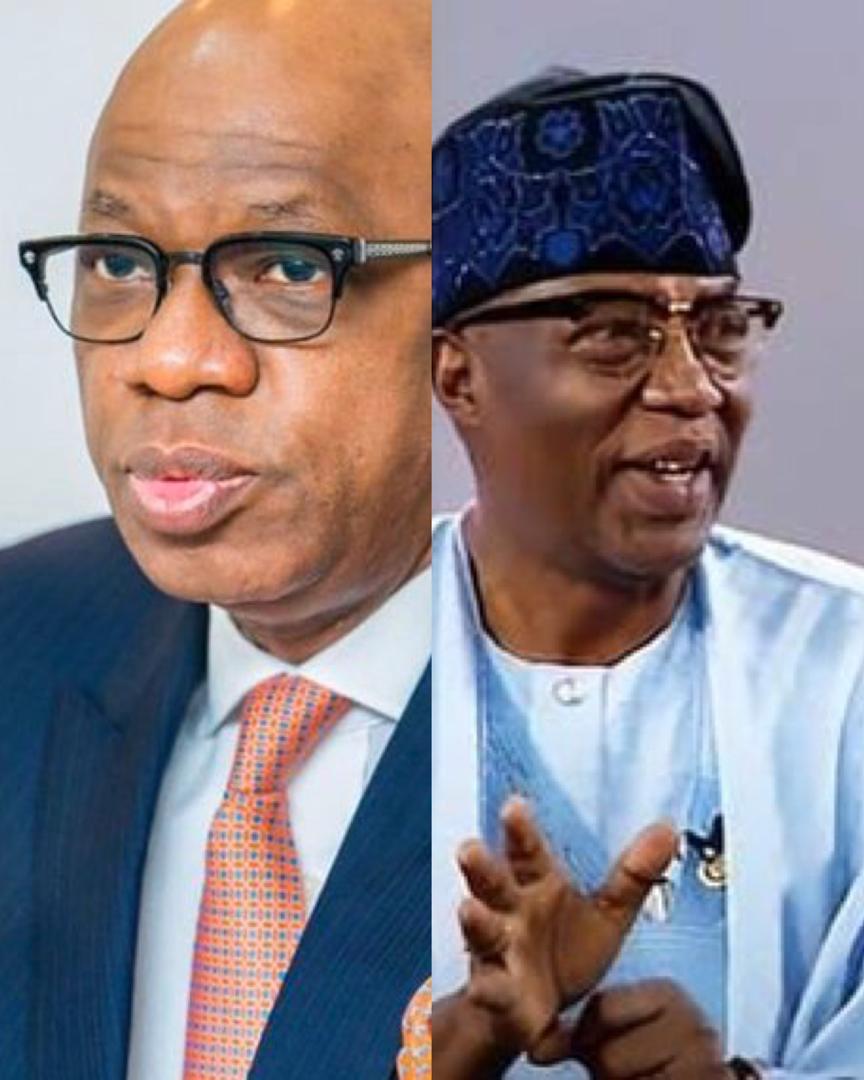
The political battle for Ogun East Senatorial District in 2027 is no longer a subject of speculation. It has moved from whispers within elite circles to an open confrontation between two of the most influential political figures in Ogun State history — Governor Dapo Abiodun and former governor, Otunba Gbenga Daniel.
What initially appeared to be a carefully managed succession arrangement within the All Progressives Congress (APC) has rapidly evolved into a looming power struggle capable of reshaping political alignments across Ijebuland and the wider Ogun political landscape.
Within hours on Tuesday, two separate political gatherings in Ijebu Ode revealed the depth of the emerging divide.
At one end was a high-level APC stakeholders’ meeting where Governor Abiodun was formally presented and endorsed as the consensus candidate for Ogun East Senatorial District ahead of the 2027 elections.
At the other end was Obalofin Court, the private residence of Senator Gbenga Daniel, where the former governor used his empowerment and midterm assessment tour to launch perhaps his strongest political criticism yet against the incumbent governor.
Together, both events confirmed one thing: the contest for Ogun East Senate may become the defining political battle in Ogun State after Abiodun leaves office in 2027.
The Consensus Strategy
Governor Abiodun’s camp appears to be pursuing a familiar Nigerian political formula — consolidate party structures early, secure elite endorsements, and discourage internal opposition before the primaries begin.
The stakeholders’ meeting held in Ijebu Ode brought together senior APC figures across Ogun East, including former deputy governors, party executives, and influential leaders within the district.
At the gathering, Abiodun was formally endorsed as the “consensus candidate” for Ogun East Senate.

To his supporters, the endorsement represented continuity, party stability, and reward for a governor completing two terms in office.
The move also carried deeper political symbolism.
In Ogun politics, consensus arrangements are often designed not merely to endorse a candidate, but to psychologically establish inevitability around such candidacy long before delegates vote.
By projecting Abiodun as the preferred choice of party elders and stakeholders, the governor’s camp appears determined to reduce the possibility of a damaging primary contest.
But Obalofin Court changed the equation.
OGD Fires Directly
Unlike previous moments when Senator Gbenga Daniel maintained cautious distance from direct confrontation with Governor Abiodun, Tuesday’s remarks were unmistakably confrontational.
The former governor did not merely question Abiodun’s Senate ambition. He questioned the governor’s legacy in Ijebuland itself.
Daniel accused Abiodun of failing to justify the enormous federal allocations now accruing to Ogun State following fuel subsidy removal.
According to him, Ogun State now receives nearly four times what previous administrations managed, yet Ijebuland has little visible development to show for it.
“For our eight years, we had access to N330 billion, but today the state operates a budget of over N1.6 trillion,” Daniel declared.
“What we received in eight years is what the state now receives within a few months, yet there is little to show for it in Ijebuland.”
It was a carefully targeted political argument.
Daniel was not merely attacking projects. He was questioning value for money, governance priorities, and regional fairness — issues capable of resonating strongly within Ogun East.
Then came the more explosive allegations.
The Dangote Refinery Question
Perhaps the most politically sensitive part of Daniel’s remarks was his attempt to reopen the long-running controversy surrounding the Dangote Refinery.
The former governor alleged that the refinery was originally meant for Ogun Waterside in Ijebuland before eventually relocating to Lagos.
Daniel further claimed that Governor Abiodun, while serving in the previous administration, played a role in negotiations surrounding the project.
“We now begin to ask the governor why he allowed the Ijebus to lose this lifetime opportunity,” Daniel said.
The allegation touches a painful nerve in Ogun politics.
For years, the relocation of the multibillion-dollar refinery project has remained one of the state’s most controversial economic debates.
However, Abiodun’s camp quickly dismissed the accusation.
Special Adviser to the Governor on Information and Strategy, Kayode Akinmade, described Daniel’s claims as “hogwash” coming from “a sinking and desperate politician.”
Akinmade insisted that former Governor Ibikunle Amosun — not Abiodun — was publicly accused by Dangote himself of frustrating the project.
“We are all in the state when Dangote said Amosun sent him packing from Ogun State,” Akinmade stated.
“How can Senator Daniel now turn around to say Amosun privately told him something different?”
The refinery argument may ultimately become less about facts and more about perception.
In politics, symbolic losses often matter as much as documented realities.
For many in Ogun East, the refinery represents a missed generational opportunity — and both camps appear ready to weaponise the narrative.
Beyond Infrastructure: The Identity Politics of Ijebuland. Another major fault line emerging in the Senate battle is the issue of Ijebu identity and regional aspiration.
Daniel accused Governor Abiodun of failing to support the agitation for Ijebu State creation — a long-standing emotional and political cause within the region.
“What we even heard the governor was doing is better not said,” Daniel remarked cryptically.
The statement appeared designed to stir deeper regional sentiment without fully elaborating the allegation.
For decades, the agitation for Ijebu State has remained one of the most symbolic political aspirations among many Ijebu elites and stakeholders.
By raising the issue, Daniel seems intent on portraying himself as more aligned with core Ijebu interests than the incumbent governor.
This explains why Tuesday’s confrontation was not merely about roads or projects.
It was also about identity, loyalty, regional memory, and political ownership of Ijebuland.
The Abiodun Counterattack
Governor Abiodun’s camp did not merely deny Daniel’s allegations. It attacked Daniel’s political credibility itself.
Akinmade accused the senator of anti-party activities and disloyalty during the 2023 elections.
“What do you expect from a desperate politician who suddenly realises the end has come to his arrogance and anti-party activities?” he asked.
The governor’s aide also argued that Abiodun has completed over 29 infrastructural projects across Ijebuland, dismissing claims of neglect as politically motivated falsehoods.
He further accused Daniel of attempting to operate outside due process regarding federal projects facilitated to Ogun East.
“Other senators like Yayi and Salisu are executing projects without drama,” Akinmade said.
“But Senator Daniel always wants to constitute himself as government.”
Then came the political dagger.
Akinmade pointed to the earlier APC stakeholders’ meeting where Abiodun was endorsed as consensus candidate, suggesting Daniel had already lost internal party backing.
“Ogun East APC stakeholders have endorsed Governor Abiodun as consensus candidate, so Daniel can continue to nurse his loss,” he said.
Will Primaries Still Hold?
This is now the biggest question in Ogun APC politics.
Will there actually be a competitive primary election for Ogun East Senate in 2027?
Or has the party establishment already decided the outcome?
Officially, APC leaders describe Abiodun’s endorsement as consensus-building aimed at preserving party unity.
But Daniel’s response suggests he has no intention of quietly stepping aside.
His insistence that he would “overwhelmingly defeat” Abiodun in a free and fair primary signals readiness for open confrontation.
The political mathematics also remain complicated.
Abiodun controls incumbency power, state structures, and significant party machinery.
Daniel, however, retains deep grassroots networks in Ijebuland, especially among older political loyalists who still view him as one of the region’s strongest political mobilisers.
The former governor also enjoys the advantage of incumbency within the Senate seat itself.
If primaries hold transparently, Ogun East could witness one of the fiercest APC internal contests since the return of democracy.
But if consensus arrangements prevail, Daniel may face difficult choices — confrontation, negotiation, or political recalibration.
A Battle Bigger Than Senate
Ultimately, the Ogun East Senate contest is evolving into something larger than a legislative ambition.
It has become a referendum on political legacy.
For Abiodun, the Senate appears positioned as the next phase of his political career after Government House.
For Daniel, the battle increasingly looks like an attempt to defend his political relevance, regional influence, and historical imprint on Ijebuland.
The coming months will determine whether APC can genuinely manage both ambitions within one structure — or whether Ogun East is heading toward a major political fracture.








Leave a comment