


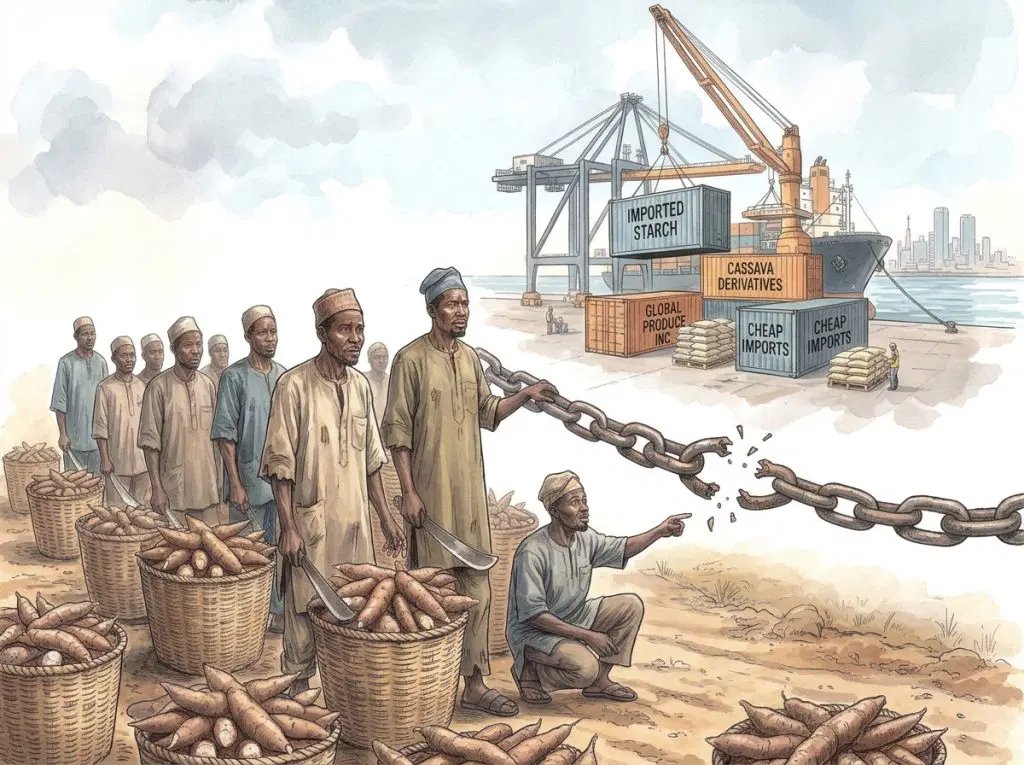
Nigeria’s cassava processing industry is facing mounting pressure as imports of cassava starch rose by 13,293 per cent between 2020 and 2025, exposing the widening gap between the country’s enormous agricultural output and its capacity to process the crop for industrial use.
The development has raised concerns among farmers, processors and industry stakeholders, who warn that rising imports, high production costs and weak demand for locally manufactured starch are threatening investments across the cassava value chain.
Data from the World Bank’s World Integrated Trade Solution (WITS), based on UN Comtrade records, show that Nigeria’s cassava starch imports increased from 24.1 tonnes in 2020 to 3,227.7 tonnes in 2025.
The figures reveal a sharp expansion in import dependence despite Nigeria’s position as the world’s leading cassava producer.
In 2020, the country imported 24.1 tonnes of cassava starch valued at $69,440. Imports rose to 54.6 tonnes in 2021 and 203.2 tonnes in 2022 before dropping sharply to 4.1 tonnes in 2023.
The decline was followed by a dramatic rebound in 2024, when imports climbed to 2,997.3 tonnes, valued at approximately $2.34 million. In 2025, imports increased further to 3,227.7 tonnes, although their value fell by 7.6 per cent to about $2.16 million.
Thailand accounted for the largest share of Nigeria’s cassava starch imports in 2025, supplying approximately 2,494.9 tonnes valued at $1.74 million. Turkey supplied 636 tonnes, while China, India and other sources accounted for smaller quantities.
The surge has intensified concerns over the survival of local processing companies and the livelihoods of farmers who depend on industrial buyers to purchase substantial quantities of their harvest.
President of the Large-Scale Starch and Derivatives Producers Association of Nigeria, Mrs Oluyemisi Iranloye, said the industry was operating under severe pressure, with some factories running at only 15 per cent of their installed capacity because of weak demand.
Iranloye, who is also Vice-President of the Industrial Cassava Stakeholders Association of Nigeria and founder of Psaltry International, said the situation had affected both processors and smallholder farmers.
She explained that farmers could spend about ₦800,000 cultivating a hectare of cassava but earn only about ₦300,000 from selling the produce at prevailing farm-gate prices.
According to her, reduced purchases by industrial processors have left farmers struggling to find buyers, resulting in falling prices, unsold harvests and mounting financial losses.
She also identified tariff disparities as a major factor undermining the competitiveness of locally produced starch.
Iranloye said reductions in import duties on competing products, including corn starch and pharmaceutical-grade starch, had made imported alternatives cheaper than locally manufactured cassava starch.
She further raised concerns about pharmaceutical-grade starch entering Nigeria under zero-duty arrangements, alleging that some importers bring in quantities beyond their immediate requirements and sell the excess into the domestic market.
The development, she warned, has weakened demand for locally produced starch and reduced the volume of cassava purchased from farmers.
Food security expert and farmer, Africanfarmer Mogaji, also attributed the crisis to the high cost of local production and the competitive advantage enjoyed by foreign suppliers, particularly Thailand.
He said processors and farmers had invested heavily in expanding production and processing capacity when local demand was stronger, but the growing availability of cheaper imported products had left many struggling to repay loans and sustain operations.
Mogaji called for consistent agricultural and industrial policies that would encourage long-term investment, while stressing the need to strengthen local processing and develop markets for cassava-based products.
Managing Director of Niji Group, Kolawole Adeniji, similarly warned that rising production costs were discouraging farmers from cultivating cassava on a commercial scale.
He identified the high cost of tractors, diesel, transportation and other farm inputs, alongside insecurity and poor market prices, as factors forcing farmers to reduce the size of their farms.
Adeniji cautioned that reduced cultivation could create further supply challenges in the coming years, adding that affordable long-term financing was essential for farmers and processors whose operations require extended production cycles.
The crisis is particularly troubling given Nigeria’s substantial cassava production capacity.
The Food and Agriculture Organization’s FAOSTAT database identifies Nigeria as the world’s largest cassava producer. However, industry stakeholders say the country has failed to translate its production advantage into sufficient industrial output and competitive exports.
President of the Industrial Cassava Stakeholders Association of Nigeria, Segun Ladele, has previously estimated that only about five per cent of Nigeria’s cassava production goes into industrial use, with the bulk consumed as food or directed to other uses.
The Central Bank of Nigeria has also acknowledged the country’s dependence on imported cassava derivatives, identifying low farm yields, inadequate processing infrastructure and weak links between farmers and industrial buyers as challenges requiring intervention.
The crisis reflects a broader problem in Nigeria’s agricultural economy: producing large volumes of raw materials without developing the infrastructure, financing and industrial capacity required to process them competitively.
Cassava can be transformed into industrial starch, high-quality cassava flour, ethanol, animal feed and other products used in food manufacturing, pharmaceuticals, textiles, paper production and other industries.
Yet, while countries such as Thailand have developed extensive processing and export industries, Nigeria continues to import processed derivatives despite its enormous production base.
Industry stakeholders are therefore calling for a review of import-duty arrangements, improved access to affordable financing, mechanisation, reliable energy, better transportation infrastructure and stronger support for local processing companies.
Without urgent intervention, the growing pressure on processors could further reduce demand for locally grown cassava, discourage farmers from planting and undermine Nigeria’s ambition to turn the crop into a major source of industrial growth, employment and foreign exchange.








Leave a comment