


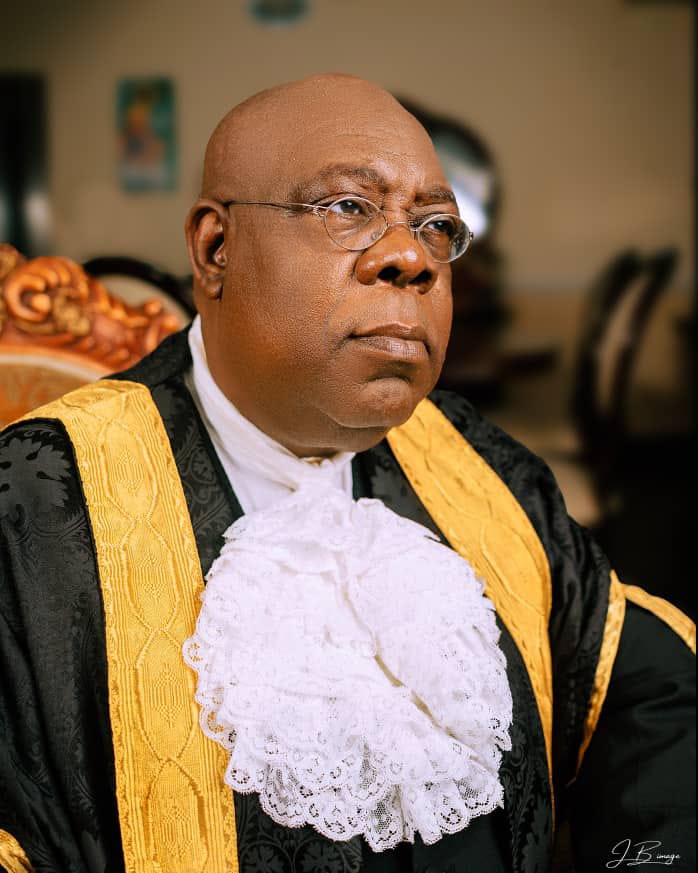

Senior Advocate of Nigeria, Asiwaju Kunle Kalejaye, has warned that the Nigerian Bar Association, NBA, could slide into deeper institutional crisis and fragmentation if its new leadership fails to urgently reconcile members, reform its electoral system and bridge the growing divisions within the legal profession.
Kalejaye, a Patron of the Nigeria Union of Journalists, Ogun East, gave the warning while reflecting on the inaugural address of the 33rd President of the NBA, Mrs. Oyinkansola Badejo-Okusanya, SAN, who formally assumed office after her swearing-in at the High Court complex in Port Harcourt, Rivers State.
Badejo-Okusanya was sworn in by her predecessor, Afam Osigwe, SAN, following her emergence from a competitive national election that was marked by controversy.
Her emergence represents a historic milestone in the history of the NBA, as she became the first woman elected President of the association through a competitive national ballot.

But for Kalejaye, the significance of the new administration goes beyond the historic nature of its leadership. He said the real test would be whether the new president could use her tenure to heal the divisions within the Bar and restore confidence in an institution expected to defend the rule of law and judicial independence.
He described Badejo-Okusanya’s inaugural address, titled “From the Call to the Cause,” as a potentially defining moment for the association, particularly because of her emphasis on building a “bolder Bar” capable of confronting the professional, economic and institutional challenges confronting its members.
According to Kalejaye, an association that seeks to speak truth to power and defend judicial independence cannot effectively perform that responsibility when it is itself divided along factional, generational, economic and geographical lines.
He therefore urged the new administration to make post-election reconciliation one of its immediate priorities, arguing that the bitterness often generated by NBA elections should not be allowed to become a permanent obstacle to the association’s development.
Kalejaye proposed what he described as an “olive branch” strategy, under which major contestants who lost the NBA election, together with influential members of their campaign teams, could be integrated into strategic committees and other areas of national administration.
He likened the approach to what he called the “Abraham Lincoln strategy,” recalling how the former American president appointed some of his major rivals for the Republican presidential nomination to important positions in his administration after winning the 1860 election.
He said the lesson was that political or professional competition should not permanently exclude capable people from contributing to the larger interests of an institution.
For the NBA, he argued, former rivals should be transformed into stakeholders and co-creators of the association’s future rather than allowed to remain at the centre of opposing factions.
Kalejaye also identified the widening economic gap between senior lawyers and younger practitioners as another threat to unity within the profession.
He urged the new administration to pursue measures that would improve the welfare of young lawyers, including standardised minimum remuneration and welfare requirements across NBA branches.
He further proposed joint mentorship programmes in which experienced practitioners would work with younger lawyers on emerging areas of legal practice, including artificial intelligence, data privacy and digital commerce.
According to him, such initiatives could turn the existing generational divide into an avenue for professional cooperation, knowledge transfer and mutual empowerment.
Another area requiring urgent attention, he said, was the conduct of lawyers on social media.
Kalejaye noted that the growing use of digital platforms had created new challenges for professional ethics, with disagreements among lawyers sometimes degenerating into public attacks, cyberbullying and conduct capable of damaging the reputation of the profession.
He therefore called for the development of a comprehensive digital ethics framework within the NBA’s professional regulatory structure.
He cited the experience of the American Bar Association and the Law Society of England and Wales as examples of how professional bodies have responded to ethical challenges created by digital communication.
Kalejaye argued that the NBA could strengthen its own professional conduct framework by establishing clearer standards for lawyers’ online behaviour and providing mechanisms through which complaints involving digital misconduct could be reviewed.
He also recommended mandatory continuing legal education programmes on digital ethics, arguing that lawyers should understand that professional responsibility does not end when they leave the courtroom or office.
Beyond professional conduct, Kalejaye urged the new leadership to address the perception that the NBA is overly concentrated around Lagos and Abuja.
He called for greater decentralisation of the association’s activities, including rotating National Executive Council meetings across the country’s geopolitical zones and providing greater financial and technical support to smaller branches.
Such a policy, he said, would make lawyers in less prominent locations feel more integrated into the national body.
Kalejaye, however, said perhaps the most sensitive challenge confronting the new administration was the credibility of the NBA’s electoral process.
He argued that controversies surrounding the association’s electronic voting system had discouraged a significant number of members from participating actively in its affairs.
He cited the position expressed by Chief Yomi Alliyu, SAN, who had argued in an opinion article that the NBA had increasingly been dominated by what he described as “political lawyers” at the expense of practising lawyers.
Kalejaye said the perception of opaque or manipulated elections could have long-term consequences for the legitimacy of the association and urged the new administration to rebuild confidence in its electoral system.
He stressed that the objective should not merely be to win elections but to create an NBA in which members who disagree with the leadership still believe they have a place and a voice.
“The silent class war must end for NBA to achieve its full potentials,” Kalejaye warned.
He also recalled the 1992 Port Harcourt Conference Crisis, describing it as a historical reminder of how serious internal disagreements could threaten the survival of the NBA as a united professional organisation.
It was against this background that he said he was initially tempted to title his reflection “Nigerian Bar Association: The Road to Kigali.”
Although he eventually rejected the headline, Kalejaye said the reference was intended as a warning about the consequences of prolonged institutional division.
He explained that “the road to Kigali” represented, in his assessment, the danger of an organisation becoming so fractured and polarised that it eventually loses its capacity to function as a single national institution.
He warned that without deliberate reconciliation and institutional reform, the NBA could face the danger of competing regional, ethnic or factional professional blocs emerging within the association.
Kalejaye, however, said he remained optimistic that the new administration could prevent such an outcome.
He said Badejo-Okusanya’s inaugural address had provided a “silver lining” which, if translated into practical policies, could enable the NBA to overcome its current challenges and emerge stronger.
He urged the new president and her executive team to seize the opportunity to build an NBA that is more inclusive, transparent, professionally responsible and responsive to the needs of lawyers across generations and regions.
According to him, the responsibility before the new leadership is enormous, but so is the opportunity to leave a lasting legacy.
He said the new administration could “etch their names in gold” if it successfully steered the association away from self-destruction and towards genuine unity.
For Kalejaye, the choice before the NBA is therefore clear: it must use the new administration as an opportunity for healing, reform and institutional renewal, or risk travelling down a path where internal divisions could threaten the very idea of a united Nigerian Bar.








Leave a comment